Imagine every possible 28 × 28 image. Almost none looks like a handwritten digit. Recognizable digits occupy a much smaller, structured part of that enormous space: a manifold. Change a digit slightly and it usually remains recognizable; follow a smooth path through valid digit images and one digit can gradually morph into another. section 5.1.2
More precisely, a manifold is a lower-dimensional subspace that looks locally like an ordinary linear space. It need not be flat overall. Picture two colored sheets of paper crumpled together: each sheet remains a continuous surface, but the colors are hard to separate in the crumpled ball. Successive neural-network layers can be pictured as small transformations that gradually uncrumple the surfaces and separate the classes. section 2.3.6 section 5.1.2
A model can fit without learning useful structure
A counterexample uses MNIST images but randomly shuffled labels: random_train_labels <- sample(train_labels) model <- keras_model_sequential() |> layer_dense(512, activation = "relu") |> layer_dense(10, activation = "softmax") model |> compile(optimizer = "rmsprop", loss = "sparse_categorical_crossentropy", metrics = "accuracy") model |> fit(train_images, random_train_labels, epochs = 100, batch_size = 128, validation_split = 0.2) With enough parameters, a model can memorize arbitrary input–label pairs. Fitting training samples alone therefore does not explain why predictions work on new digits; their structured input space matters. section 5.1.2
A model that approximates the data’s latent manifold can generalize by interpolating between training samples. That does not promise sensible predictions everywhere: inputs far from those seen during training remain a problem. Even between two valid digits, a straight pixel-by-pixel average may not itself look like a valid digit; a path along the manifold is different. section 5.5 section 5.1.2
Figure 5.8 Difference between linear interpolation and interpolation on the latent manifold. Every point on the latent manifold of digits is a valid digit, but the average of two digits usually isn’t.
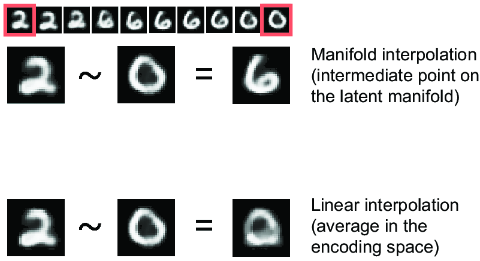
Compare straight interpolation between digit images with interpolation along the latent manifold; the figure makes the distinction between an average image and a valid digit visible. section 5.1.2


