A manifold generalizes curves, surfaces, and volumes to arbitrary dimensions. A d-manifold is a space whose every point has a neighborhood that maps one-to-one to a region of ℝ^d without folding, twisting, or tearing. Thus, each small neighborhood looks locally flat even when the whole space is curved. This local Euclidean structure supports calculus and geometric reasoning in machine learning. section 12.1 section 12.4
Key properties and interpretations include:
- A continuous curve, such as a circle, is a 1-manifold; a sphere is a 2-manifold. section 12.1
- A manifold satisfies local Euclidean, Hausdorff, and second-countable properties; it may include a boundary, as a disk does. section 12.1.2 section 12.4
- In classification, neural-network layers map an input manifold through successive manifolds toward one where classes can be separated by a hyperplane. section 12.1 section 12.4
A homeomorphism is a continuous, one-to-one transformation with a continuous inverse. It stretches or squishes a manifold without cutting, breaking, or folding, and preserves path-connectedness. This provides a geometric interpretation of neural networks: successive layers reshape the input manifold so that a final linear separator can distinguish classes. section 12.2 section 12.3
Unrolling a cylindrical manifold
Two classes arranged on a cylindrical surface may not be linearly separable in their original space. Unrolling the cylinder into a plane preserves the surface's structure while producing a representation in which a straight line separates the classes.
Figure 14.6 Two examples of mapping from a 2D input space to a 1D latent space. Both show regularized solid) vs. unregularized (dashed) latent space manifolds. Solid little circles depict training data points.
|
(a) Linear latent space |
|
(b) Curved latent space |
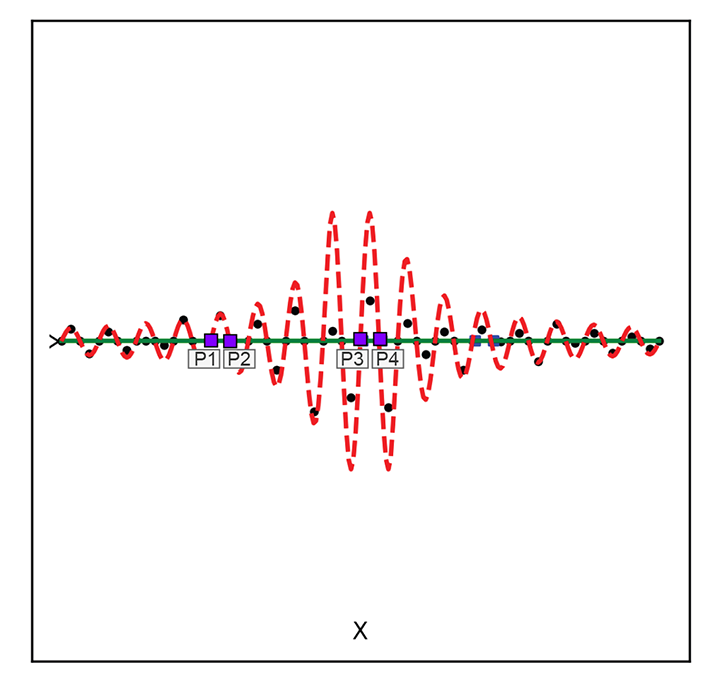
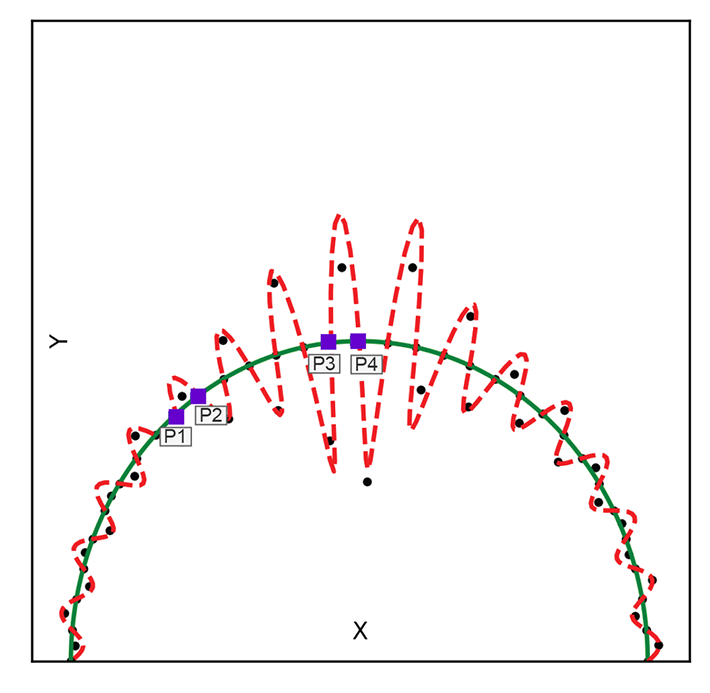
Compare smooth and zigzag one-dimensional latent manifolds: both can reconstruct training data, but the smoother manifold preserves distances more consistently and is preferred under regularization. section 14.6


