Feature engineering means using knowledge of the data and the learning algorithm to transform inputs before they reach a model. These transformations are hardcoded, not learned. The aim is to express the problem in a form that makes useful patterns easier to find. section 5.4.2
Reading a clock
Imagine predicting the time from a photograph of a clock. Raw pixels make this a demanding image-learning problem. Instead, a short R script could locate the tips of the hands and supply their (x, y) coordinates. A simple model could then associate those coordinates with times. Convert the coordinates to angles around the clock’s center, and even that model may be unnecessary: rounding and a lookup can recover the approximate time. section 5.4.2
Figure 5.17 Feature engineering for reading the time on a clock
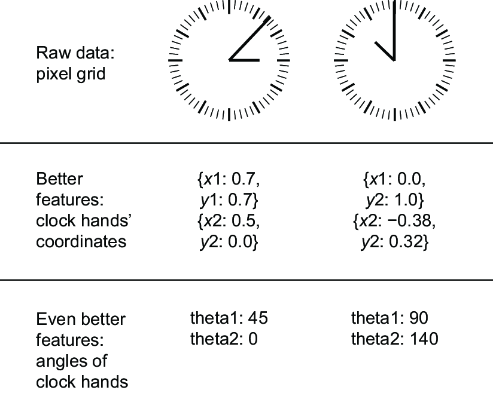
The clock diagram shows how changing the input representation can simplify the prediction task. section 5.4.2
When developing a model:
- Filter out uninformative inputs through feature selection, then use problem knowledge to create promising new features. section 6.2.3
- Consider the features alongside the model architecture. A suitable representation helps direct learning toward useful solutions; a model may fail to find a simple solution even when it can represent one. section 13.2.3
- Keep data quality in view. Informative, less noisy features make the input space better structured and support generalization. section 5.1.2
Deep learning learns many representations that once had to be designed by hand, but this does not make input quality irrelevant. Nor is manual feature engineering the same as feature extraction from a pretrained model: that technique reuses representations the model has already learned. section 1.7 section 8.3.1















