liveBook · Manning

Feature engineering

As explained in Distributed Machine Learning Patterns

Feature engineering is the process of creating, transforming, or selecting input features to improve a machine learning model.

Feature engineering creates derived inputs before fitting a model. Combining overlapping audiovisual features can improve performance, although extensive combinations may make training impractical on a single GPU. section 3.2.2

Use feature engineering to:

  • Combine features from related entities when they provide similar or overlapping information. section 3.2.2
  • Balance potential model-performance gains against the cost of exploring many feature combinations. section 3.2.2
  • Recognize that deep learning models can learn relationships among features through trained weights and biases. section 3.2.2

Animal and Pet video entities

Audiovisual features from Animal and Pet can be combined because the entities overlap. The resulting derived feature may improve classification, depending on the selected model. section 3.2.2

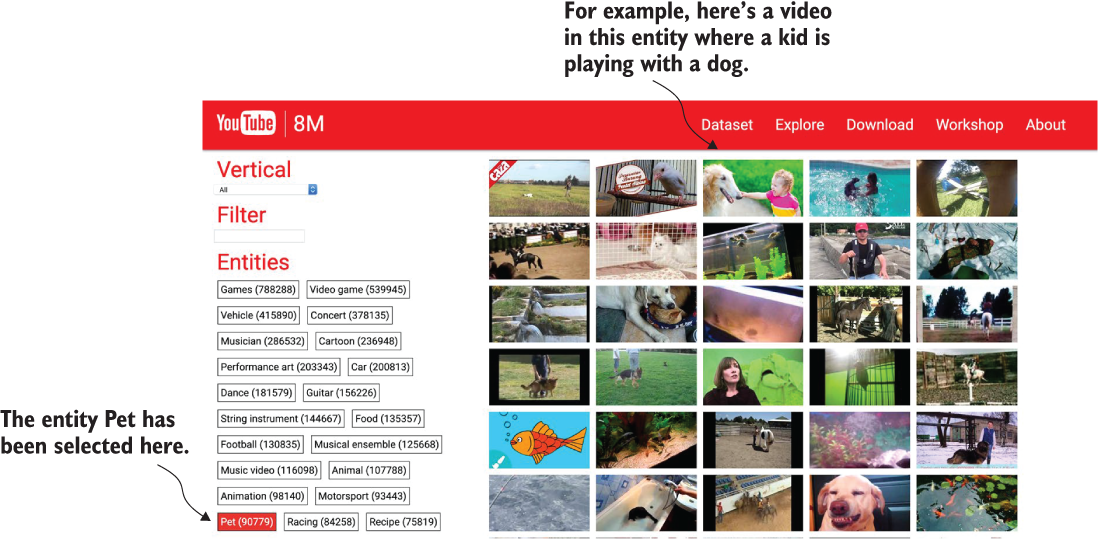
Figure 3.4 Example videos that belong to the Pet entity (Source: Sudheendra Vijayanarasimhan et al. Licensed under Nonexclusive License 1.0)
03-04

Inspect Pet videos alongside the Animal examples to identify relationships that may motivate derived features. section 3.2.2


How Distributed Machine Learning Patterns covers it

How deep it goes
Explains derived-feature construction and its performance rationale, then stops short of a procedural feature-engineering workflow.
Examples
Uses overlapping Animal and Pet audiovisual features and a 10-class LeNet classification scenario.
What it assumes
Assumes familiarity with model fitting and audiovisual entity features, while contrasting traditional feature engineering with deep learning.
What you can do after
Evaluate whether combining overlapping audiovisual features is worthwhile before training, especially when exploration threatens single-GPU training time.
How it connects
Connects derived features with model selection, dataset exploration, traditional machine learning, and deep learning.

Also explained in

Compare how 16 books explain feature engineering →

Related concepts

This explainer was generated by Manning's knowledge graph from the text of Distributed Machine Learning Patterns. The section links point to the parts of the book it draws on.













