liveBook · Manning

Feature engineering

As explained in Delivering Machine Learning Projects: From design to deployment

Feature engineering is the transformation of raw data into informative input variables that represent useful structure for a machine learning model.

Feature engineering transforms raw data into consistent, useful, and informative inputs for machine-learning algorithms. It belongs in the core ML pipeline, before modelling, and supports both technical data quality and the encoding of human insight. section 7.2

Turn the work into an executable delivery ticket:

  • Create and review a feature-engineering plan with the team. section 7.2
  • Implement a feature-engineering pipeline that transforms raw data for algorithm consumption. section 7.2
  • Inspect repeated information, distribution skews, scale differences, and hierarchical data before modelling. section 7.2
  • Design and add data augmentation where the available data or features are insufficient. section 7.2

Representing cyclic time

A model may not infer that January 1 follows December 31 when dates are represented as 1 and 12. Feature engineering can encode the calendar’s cyclical structure rather than leaving the algorithm with disconnected scalar values. section 7.2

Figure 7.1 Temperatures plotted by day of the year (data for Suffolk Wattlesham weather station, 2019, from UK Government).
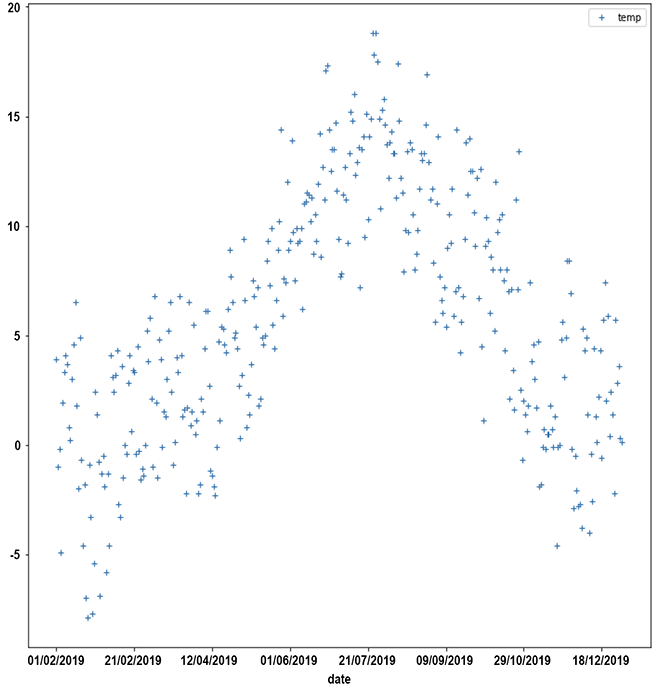
Compare temperatures plotted by day of year with an alternative representation based on distance from midsummer. section 7.2


How Delivering Machine Learning Projects: From design to deployment covers it

How deep it goes
Explains planning, pipeline implementation, bias handling, structural transformations, and augmentation, without deep algorithmic exposition.
Examples
Uses calendar sequences, directional values, and temperature plots to illustrate informative representations of cyclical or structured data.
What it assumes
Assumes assembled raw data and familiarity with ML algorithms, while explaining why preprocessing must make data consistent and informative.
What you can do after
Build it from scratch by planning, implementing, reviewing, and augmenting a feature-engineering pipeline.
How it connects
Connects feature selection, data augmentation, preprocessing, model development, and AutoML with the preparation and assessment of model inputs.

Also explained in

Compare how 16 books explain feature engineering →

Related concepts

This explainer was generated by Manning's knowledge graph from the text of Delivering Machine Learning Projects: From design to deployment. The section links point to the parts of the book it draws on.













