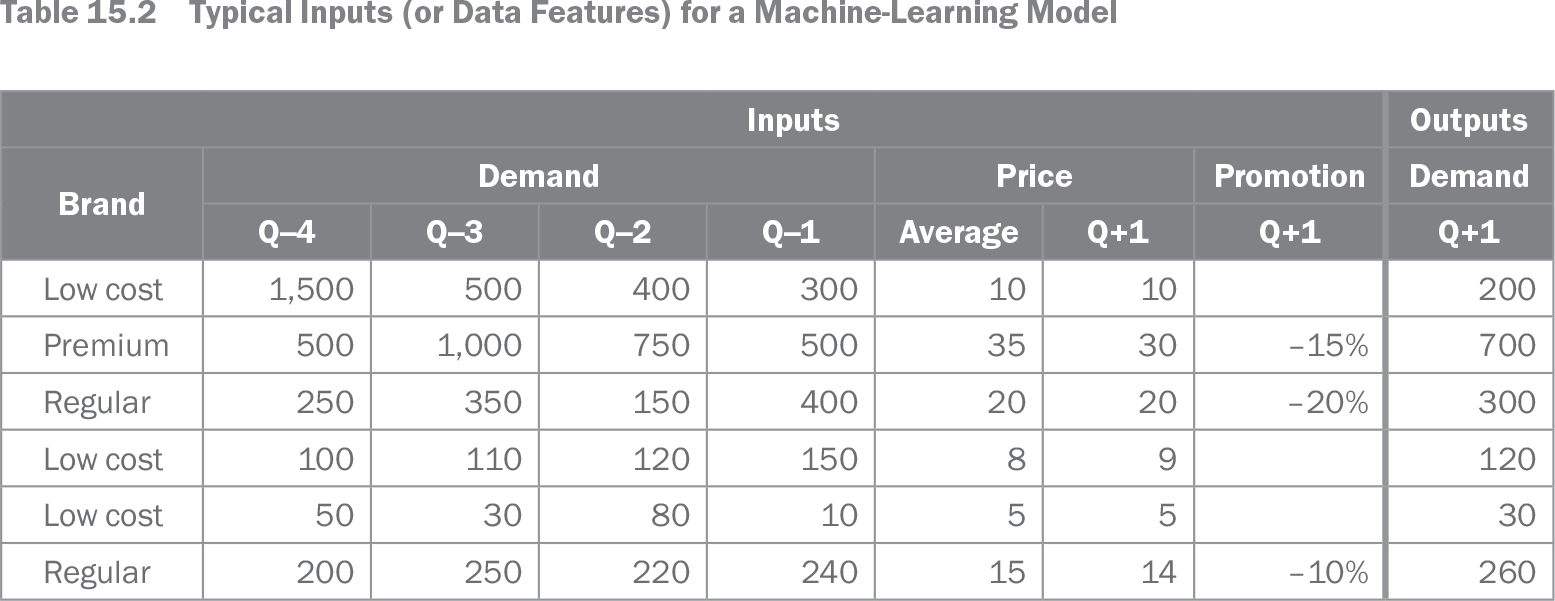
Feature engineering selects, creates, or tweaks the data features supplied to a machine-learning model. For demand forecasting, business knowledge helps identify information the model would otherwise miss, such as whether a product will be on sale during Black Friday. section 15.1.1
Begin with the decision question: if forecasting next month’s demand, what would you ask or check? Brainstorm with people who understand pricing, promotions, inventory, and demand before collecting the required data. section 15.1.1
Useful brainstorming prompts include:
- What is the current price, and has it changed recently? section 15.1.1
- What is the product’s average monthly demand? section 15.1.1
- Was the product recently out of stock, or is a promotion running? section 15.1.1
Table 15.2 Typical Inputs (or Data Features) for a Machine-Learning Model (view table figure)
| Inputs |
Outputs |
||||||||
|---|---|---|---|---|---|---|---|---|---|
| Brand |
Demand |
Price |
Promotion |
Demand |
|||||
| Q–4 |
Q–3 |
Q–2 |
Q–1 |
Average |
Q+1 |
Q+1 |
Q+1 |
||
| Low cost |
1,500 |
500 |
400 |
300 |
10 |
10 |
|
200 |
|
| Premium |
500 |
1,000 |
750 |
500 |
35 |
30 |
–15% |
700 |
|
| Regular |
250 |
350 |
150 |
400 |
20 |
20 |
–20% |
300 |
|
| Low cost |
100 |
110 |
120 |
150 |
8 |
9 |
|
120 |
|
| Low cost |
50 |
30 |
80 |
10 |
5 |
5 |
|
30 |
|
| Regular |
200 |
250 |
220 |
240 |
15 |
14 |
–10% |
260 |
|
Compare typical model inputs—including brand, price, promotion, and historical demand—with predicted demand. section 15.1.1