Feature engineering creates new model inputs from existing variables so the data is more useful for prediction. It can improve model performance through transformations, and it is sometimes required because a raw value cannot be used directly by a model. section 1.2.7
Figure 1.4 A sample data science workflow. Data science workflows involve key steps like gathering data, exploring and cleaning the data, feature engineering, and model development. The model evaluation piece is also a highly important step, that we will cover in detail when we discuss model monitoring later in this book.
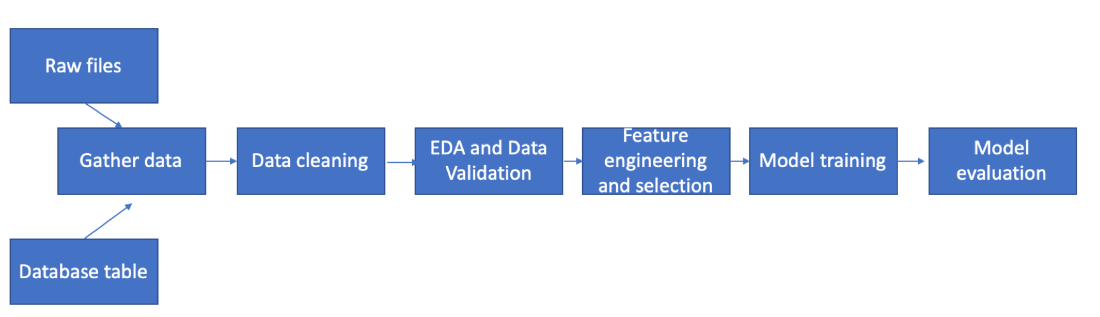
Feature engineering sits between data cleaning and model development in a broader workflow that also includes gathering, exploring, and evaluating data. section 1.2.7
Common ways to engineer features include:
- Transform a variable when a model benefits from inputs with a normal distribution. section 1.2.7
- Parse a transaction date into day of week, hour of day, or month for a credit-fraud prediction task. section 1.2.7
- Bucket a customer’s age into ranges such as under 18, 18–24, 25–30, and 31–40 for customer-churn prediction. section 1.3.1
- Create indicator columns from a categorical site-category field, such as one column for each selected category. section 8.1.2
Choose where the transformation runs
A bucketed_age feature can be created in the data pipeline as a table column, or after extraction in preprocessing code before model input. The important practical choice is to make the transformation part of the path from source data to the finalized training dataset. section 1.3.1 section 1.4.2
Listing 8.10 We can create new columns in Dask the same way we do in pandas.
#1
ad_frame["site_category_28905ebd"] =
     ad_frame.site_category.map(lambda val:
     1 if val == "28905ebd" else 0)

ad_frame["site_category_50e219e0"] =
     ad_frame.site_category.map(lambda val:
     1 if val == "50e219e0" else 0)
This Dask example creates two new indicator columns from site_category with map operations, illustrating feature creation in a dataframe workflow. section 8.1.2
Treat feature engineering as an operational component, not only an experiment. It may live in data-pipeline tables or preprocessing code, may be split across multiple files, and needs monitoring because corrupted or missing feature logging can reduce prediction accuracy. Extra feature steps can also affect memory consumption in chunked workflows. section 1.4.2 section 1.4.6 section 7.7























