liveBook · Manning

Collection

As explained in Build an Advanced RAG Application (From Scratch)

A document collection is a set of documents grouped by a shared domain, document type, or retrieval purpose.

A collection groups documents by shared domain, document type, or retrieval purpose. In a RAG system, purpose-built collections prevent unrelated documents from competing in one vector space and degrading retrieval precision. section 7.2

Partitioning creates a routing requirement: each query must reach the collection or retrieval backend suited to its intent. Financial questions can target financial filings, technical questions documentation, and broader questions the live web. section 7.2

Purpose-built retrieval

Route “How do I create an assistant with file search?” to an OpenAI documentation collection, while routing “What was Uber's revenue last quarter?” to financial filings. section 7.2

Figure 7.2 Agentic Router: A contrast between two frameworks, one that uses central knowledge retrieval (left) vs. a router-based approach to retrieve data from relevant repositories (right)
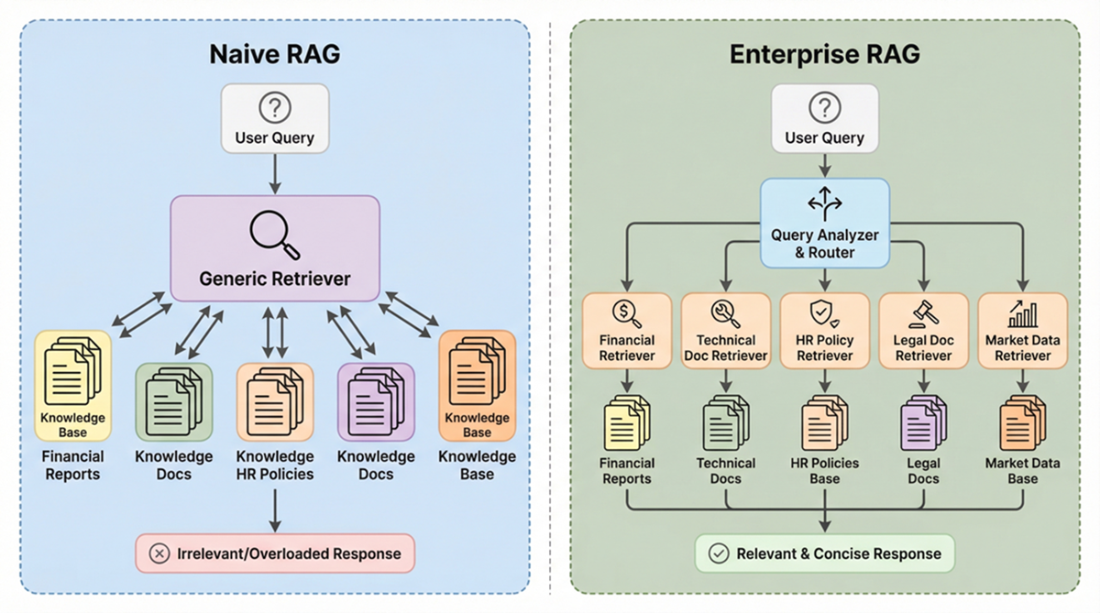
Compare centralized knowledge retrieval with routing across relevant repositories. section 7.2


How Build an Advanced RAG Application (From Scratch) covers it

How deep it goes
Explains partitioning rationale and routing consequences, but does not detail collection implementation or indexing procedures.
Examples
Uses financial filings, technical documentation, OpenAI documentation, and live web search as distinct retrieval destinations.
What you can do after
Apply it via agentic routing to direct queries toward domain-appropriate document repositories.
How it connects
Links collections to embeddings, vector spaces, semantic search, retrieval backends, and agentic routing.

Also explained in

Compare how 17 books explain collection →

Related concepts

This explainer was generated by Manning's knowledge graph from the text of Build an Advanced RAG Application (From Scratch). The section links point to the parts of the book it draws on.














