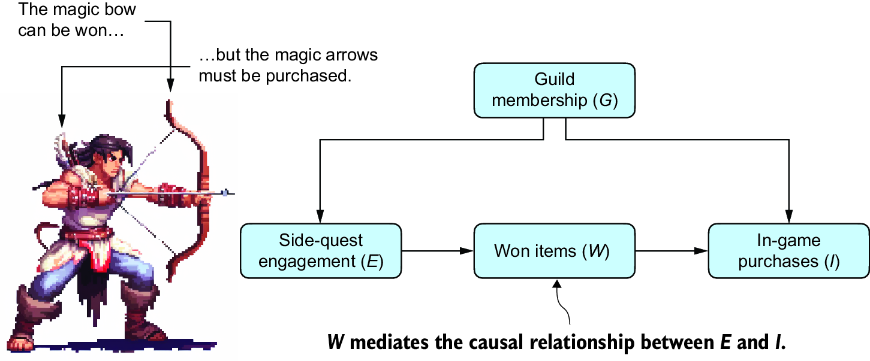
A mediator is an intermediate variable through which part or all of an exposure’s causal influence reaches an outcome. It differs from a confounder: it lies on the causal path rather than creating a shared cause. In the gaming example, side-quest engagement produces won items, which encourage in-game purchases. section 10.5.1 section 13.1.1
Mediators support front-door identification when direct backdoor adjustment is unavailable. The front-door estimand uses the mediator to separate causal flow from association confounded by an unobserved variable, rather than treating every observed covariate as an adjustment variable. section 10.5.2 section 11.4.1
A front-door analysis requires three conditions:
- Require full mediation: the mediator blocks every directed path from treatment to outcome. section 11.3.3
- Require first-stage unconfoundedness: hidden variables do not confound treatment and mediator. section 11.3.3
- Require second-stage unconfoundedness: hidden variables do not confound mediator and outcome after accounting for treatment. section 11.3.3
Won items as a mediator
Let E represent side-quest engagement, W won items, I in-game purchases, and G guild membership. The graph contains G→E, G→I, E→W, and W→I. Because W lies between E and I, graphical identification can derive a front-door estimand for the effect of E on I, provided the stated assumptions hold. section 10.5.1 section 11.3.3
Figure 10.11 Side-quest engagement leads to winning virtual items like this magic bow. Won items drive more in-game purchases, such as magic arrows for the magic bow, so we introduce a mediator “won items” on the causal path between side-quest engagement and in-game purchases.
Use the causal diagram to trace treatment, mediator, outcome, and the unobserved confounding path visually. section 10.5.1

