A message broker is the mailroom between services: it receives messages, routes them to the right destination, and holds them until a consumer is ready. The producer can move on without waiting for the consumer to be online. That separation in time is called temporal decoupling. section 7.2 section 7.2.1
Figure 7.3 The Broker acts as the buffer. The Producer speaks to the Broker, not the Consumer.
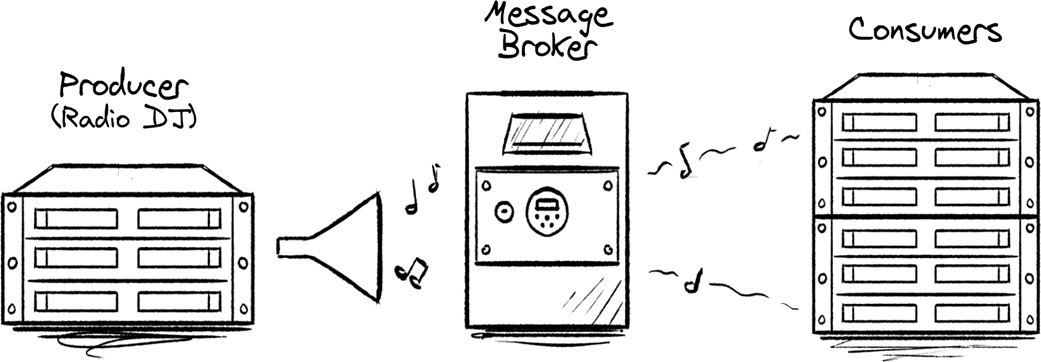
See how the broker buffers messages between a producer and a consumer. section 7.2.1
An order takes a detour
An Order Service publishes an Order Placed event and moves on. The broker holds it; when the Shipping Service is ready, it receives the event and prints a label. Shipping can be offline when the order is placed, but there is a gap before its work is complete. section 7.2.1 section 7.9
A message typically makes four handoffs:
- Publication: The producer sends the event and moves on after the broker acknowledges receipt. section 7.4.3
- Enqueue: The broker persists the event and holds it for a consumer. section 7.4.3
- Consumption: A consumer receives the message, which is usually locked while it works. section 7.4.3
- Acknowledgment: After processing, the consumer sends an ACK. If it crashes first, the broker can put the message back for another attempt. section 7.4.3
Retries protect work, but they can also repeat it. If shipping prints a label and crashes before acknowledging, a retry can print a second label. Idempotency addresses the consequences of repeated processing; some brokers also offer duplicate detection based on message IDs. Dead letter queues catch messages that would otherwise repeatedly crash consumers, and they need monitoring. section 7.4.3 section 7.5.1 section 7.9
Choose a broker for the job, not its popularity. RabbitMQ favors flexible routing and low latency but needs operational care; Kafka favors scale and replayable history but brings operational complexity and batching latency. section 7.2.1
Table 7.1 Choose your “Middleman”: Broker Comparison
|
Tool
|
Link
|
The Vibe
|
Best For
|
The Tradeoff
|
|
Rabbit MQ
(The Swiss
Army Knife)
|
“Smart Broker, Dumb Consumer.”
|
Complex routing, flexible fan-out, and multiple protocol
support (AMQP, MQTT).
|
Very low latency, but doesn't reach Kafka-level scale;
requires more "Ops love."
|
|
|
Apache Kafka
(The Firehose)
|
“Dumb Broker, Smart Consumer.”
|
Massive scale, replayable history, and stream processing.
|
Insane throughput, but higher latency due to batching;
high operational complexity.
|
|
|
AWS SQS/SNS
(The Serverless Choice)
|
“Set it and Forget it.”
|
Serverless teams who want zero management; SQS for queues,
SNS for fan-out.
|
Easy scaling and zero maintenance, but introduces vendor
lock-in and higher costs at scale.
|
|
|
Azure Service Bus
(The Enterprise Choice)
|
“RabbitMQ’s Corporate Cousin.”
|
Complex enterprise features like sessions (FIFO),
transactions, and duplicate detection.
|
Rich feature set with deep Azure integration, but higher
latency than raw open-source tools.
|
Compare broker options and their operational tradeoffs. section 7.2.1