Message passing lets isolated processes exchange data without shared memory. A sender uses send/2, continues asynchronously, and places a term in the receiver’s mailbox; the receiver uses receive to select matching messages. section 5.2.1 section 5.2.2
Use the mechanism according to the communication pattern:
- Use fire-and-forget messaging when the caller needs no result or completion notification. section 5.2.1
- Build a response protocol by including the caller’s PID, then having the worker send a tagged response such as {:query_result, result}. section 5.2.2
- Pattern-match message shapes in receive and add an after clause when waiting indefinitely would be unsafe. section 5.2.2
- Scale the same primitive across nodes: services such as :rpc send requests to registered remote processes and receive their responses. section 12.1.5
Collecting concurrent query results
Store the caller before spawning so self() refers to the original process, not the worker: caller = self(); spawn(fn -> result = run_query.(query); send(caller, {:query_result, result}) end). The caller can then repeatedly receive {:query_result, result} messages and assemble results in completion order. section 5.2.2
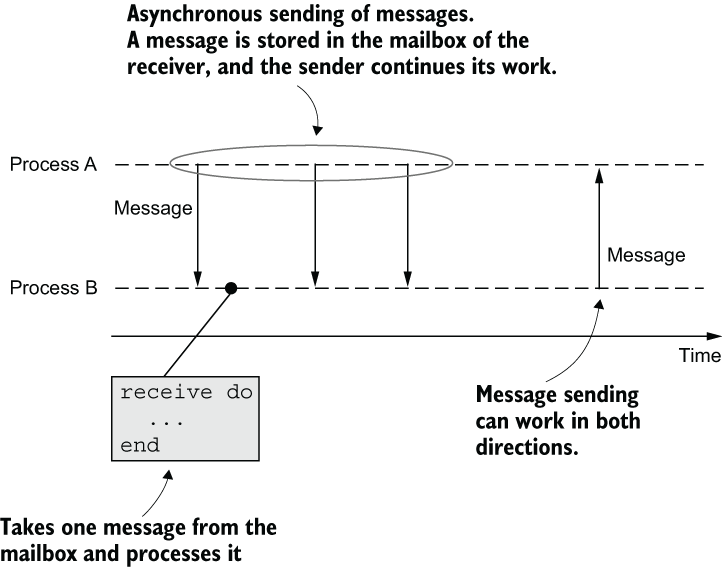
Use the inter-process communication figure to visualize messages moving between independent processes. section 5.2.2








