Message passing lets graph neural networks update each node by collecting information from neighbors, processing it, and combining it with the node’s representation in repeated rounds. section 11.5.1
A typical message-passing pipeline proceeds as follows:
- Collect messages from neighboring nodes. section 11.5.1
- Aggregate the messages, commonly by summation, then update the node representation with trainable weights, a nonlinear activation, and optionally a bias. section 11.5.3
- Repeat the process so that k iterations expose each node to information from its k-hop neighborhood. section 11.5.2
Social-network interests
A user representation can begin with explicitly stated interests, incorporate friends’ interests in the first round, and incorporate friends-of-friends’ interests in the second. Later rounds capture broader social patterns. section 11.5.1
Adding self-loops folds a node’s own information into neighborhood aggregation, simplifying implementation and often improving stability, but it reduces flexibility in distinguishing self-features from neighbor features. Specialized aggregation, attention, skip connections, and normalization extend the framework for irregular neighborhoods and deeper models. section 11.5.4 section 11.6
Figure 11.5 Example of how a single node aggregates messages from its local neighborhood in the message-passing model. Notice that the computation graph of the GNN forms a tree structure by unfolding the neighborhood around the target node.
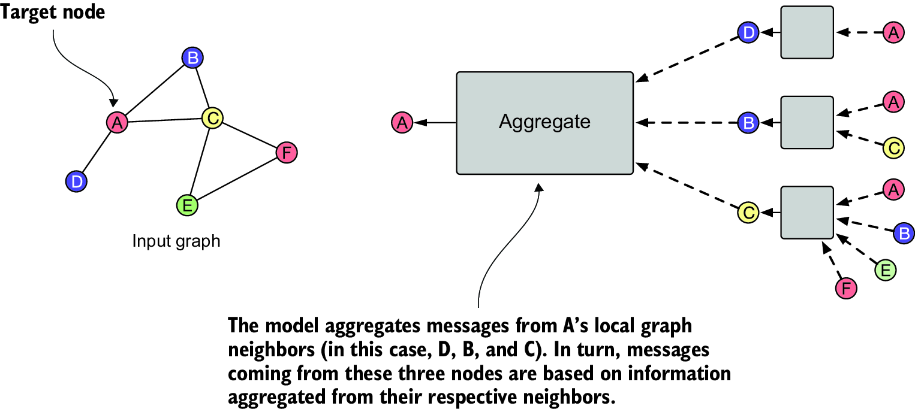
Unfolds a target node’s local neighborhood into a computation tree, showing how messages are aggregated during graph-neural-network inference. section 11.5.1








