Microservice architecture organizes a system as independently deployable services, each focused on a capability and communicating through defined interfaces. It can let teams own and scale distinct capabilities separately, but it also makes communication paths, computation placement, and behavior under load central performance concerns. section 5.3 section 5.3.1
Choose it for constraints, not fashion. A synchronous call in a request path can add hundreds of milliseconds, while distributed systems also require operational capacity such as distributed tracing and on-call support. Compare simplicity, flexibility, and speed against team size, user geography, and real scaling needs. section 5.3
Evaluate the pattern through its workload and organization:
- Favor decomposition when capabilities have different scaling characteristics and separate teams need independent deployment. section 5.3.1
- Prefer consolidation when work is computationally intensive and self-contained rather than coordination-heavy. section 5.3.1
- Treat distributed orchestration and inter-service data transfer as costs that can become scaling limits. section 5.3.1
Two opposite architectural outcomes
Prime Video’s distributed AWS Step Functions, Lambda, and S3 design reached a scaling limit at 5% of expected load; consolidating it into one process cut infrastructure costs by 90%. Netflix instead migrated over seven years from a monolith after a database-corruption outage, ultimately operating more than 1,000 microservices for distinct capabilities and teams. section 5.3.1
Figure 5.6 Monolith vs microservices latency
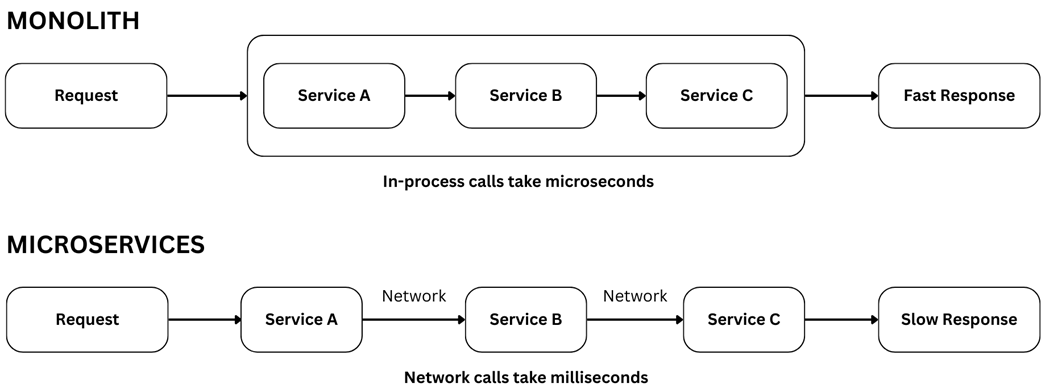
Compare the latency implications of a monolith and microservices when deciding whether extra service boundaries justify their communication cost. section 5.3.1