Microservice architecture organizes an application into two or more loosely coupled, independently deployable services. Each service is a deployable unit that implements one or more business capabilities. The goal is not tiny services; it is an architecture that supports fast, sustainable delivery. section 1.3.1 section 7.1.3
Loose design-time coupling means a change to one service rarely requires changes to another. Independent deployability means a service has its own deployment pipeline and can be made production-ready through testing in isolation. Together, these properties let teams work with less coordination and keep pipelines focused on smaller codebases. section 1.3.1 section 1.3.2
Figure 1.10 A service must be independently deployable: packaged as a deployable or executable unit, has its own deployment pipeline and is production-ready after it has been tested in isolation.
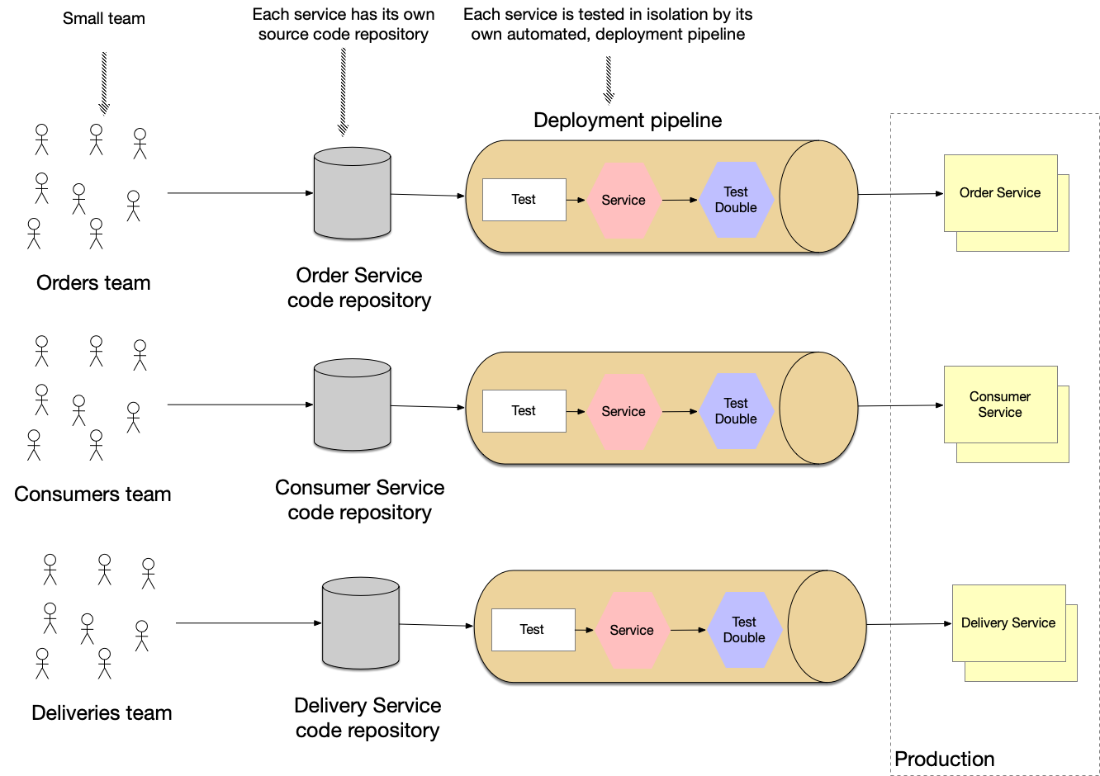
The figure summarizes what independent deployability requires of a service. section 1.3.1
Food delivery application
A food delivery application can separate customer, order, and delivery capabilities into services behind an API gateway. Creating a customer can stay within the customer service, while creating an order can span services. Cross-service work must account for network failures and service availability. section 1.3.1 section 1.3.4
Consider the trade-offs before choosing this architecture:
- Faster delivery at scale: loosely coupled services and dedicated pipelines can improve team autonomy and reduce deployment lead time. section 1.3.2
- Technology and isolation: services can use different stacks or isolate functionality with distinct availability, scalability, or security needs. section 1.3.3
- Distributed complexity: operations spanning services must handle network failures, latency, availability, and transaction boundaries. Synchronous dependencies can introduce runtime coupling. section 1.3.4
- Coupling risk: excessively fine-grained services can create a distributed monolith, with tightly coupled changes, runtime dependencies, and poor performance. section 2.3
For a new application, start with a monolith unless there is a compelling need for multiple technologies or separate deployment of modules with different characteristics. Early service boundaries and APIs are difficult to stabilize when the domain is not yet well understood. section 1.4.1
For an existing monolith, establish whether architecture is actually slowing delivery. First consider modularization, an automated deployment pipeline, DevOps, and team organization. If these are insufficient and microservices offer tangible benefits, migrate incrementally rather than attempting a big-bang rewrite; incremental changes provide earlier value and design feedback. section 1.4.2 section 2.3