liveBook · Manning

Mocking

As explained in Kafka for Architects

A mock is a test double that imitates a dependency and records or verifies interactions with it.

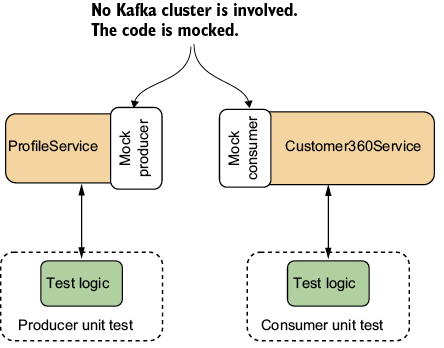
Mocking isolates a service from external dependencies during unit testing. A mock producer or consumer replaces Kafka infrastructure so tests can focus on observable behavior, such as returned values, side effects, or expected producer calls. section 10.3.1

Use mocking to:

  • Verify that a service passes the correct data to a Kafka producer. section 10.3.1
  • Invoke a consumer handler with a deserialized message and inspect downstream side effects or state changes. section 10.3.1
  • Keep unit tests independent of a Kafka cluster and real network communication. section 10.3.1
Figure 10.6 Unit testing Kafka components using mock implementations. The services are tested in isolation by replacing the actual Kafka producer and consumer with mocks. This allows the test logic to focus on verifying functional behavior without involving a Kafka cluster or real network communication.
A screenshot of a computer

AI-generated content may be incorrect.

Shows services tested in isolation by replacing real Kafka producers and consumers with mock implementations. section 10.3.1


How Kafka for Architects covers it

How deep it goes
Defines dependency replacement and interaction verification, but defers actual Kafka behavior and message flow to integration tests.
Examples
Uses ProfileService producer calls, consumer handlers, and mock producer or consumer implementations.
What it assumes
Assumes component-level testing knowledge and teaches isolation through public behavior rather than private methods.
What you can do after
Evaluate/understand component behavior by checking return values, side effects, or producer calls without a Kafka cluster.
How it connects
Connects unit testing with fakes, integration testing, Kafka producers, Kafka consumers, and message flow.

Also explained in

Compare how 21 books explain mocking →

Related concepts

This explainer was generated by Manning's knowledge graph from the text of Kafka for Architects. The section links point to the parts of the book it draws on.


















