liveBook · Manning

Monte Carlo simulation

As explained in Build AI Drug Discovery Pipelines

A Monte Carlo method uses random sampling to approximate quantities or explore states in a system with many possible configurations.

Monte Carlo simulation uses random moves to explore many possible protein conformations. By occasionally accepting higher-energy states, it can cross energy barriers and avoid local minima. section 12.1.2

Figure 12.4 The protein folding energy landscape funnel transitions from high-energy unfolded states to the low-energy native state, with decreasing entropy and conformational freedom.
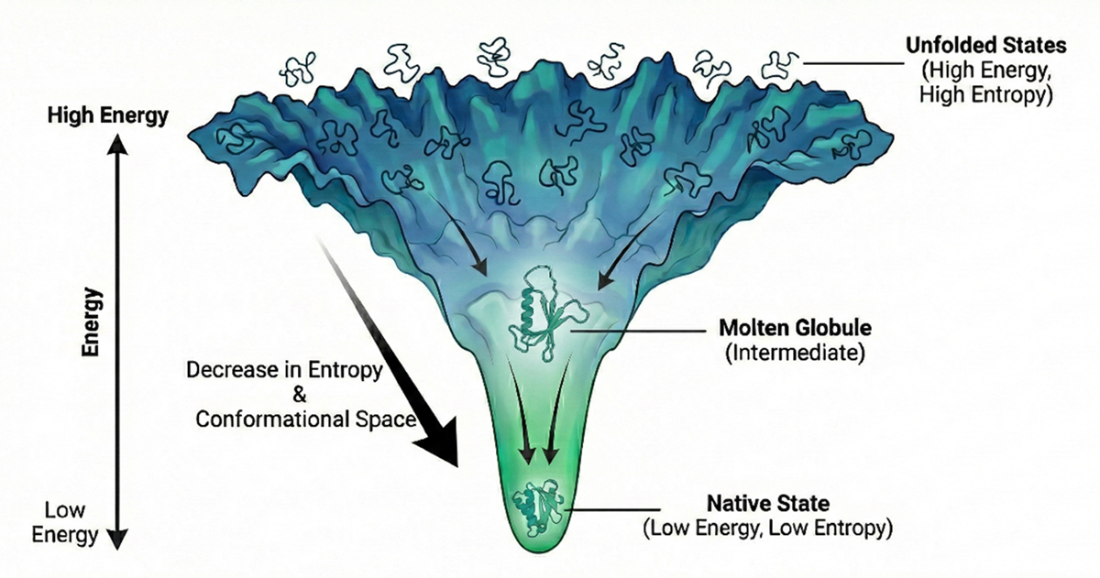
The energy-landscape funnel illustrates why stochastic exploration matters: proteins move among high-energy, highly flexible states while seeking lower-energy conformations. section 12.1.2


How Build AI Drug Discovery Pipelines covers it

How deep it goes
Explains random moves, higher-energy acceptance, energy barriers, and local minima, but does not develop implementation details or equations.
Examples
Uses protein conformations, rugged energy landscapes, and the transition from unfolded states toward native structures.
What you can do after
Evaluate/understand why random sampling helps explore protein conformations beyond local energy minima.
How it connects
Connects protein folding with energy landscapes, molecular dynamics, physics-based simulation, and deep learning.

Also explained in

Compare how 11 books explain Monte Carlo simulation →

Related concepts

This explainer was generated by Manning's knowledge graph from the text of Build AI Drug Discovery Pipelines. The section links point to the parts of the book it draws on.








