A linear layer connects every node to every non-bias node in the next layer. It skips no nodes within that adjacent layer, and connections do not jump across layers. Bias nodes are part of the architecture but are not counted in a layer’s size. section 10.1
A neural network arranges nodes into an input layer, hidden layers, and an output layer. Its depth counts layers after the input layer. For example, an input layer of size 4, hidden layers of sizes 5 and 3, and an output layer of size 1 have depth 3. section 10.1
Figure 10.14 The general architecture of a neural network. The nodes are divided into layers, where the leftmost layer is the input layer, the rightmost layer is the output layer, and all the layers in between are hidden layers. All the nodes in a layer are connected to all the (non-bias) nodes in the next layer.
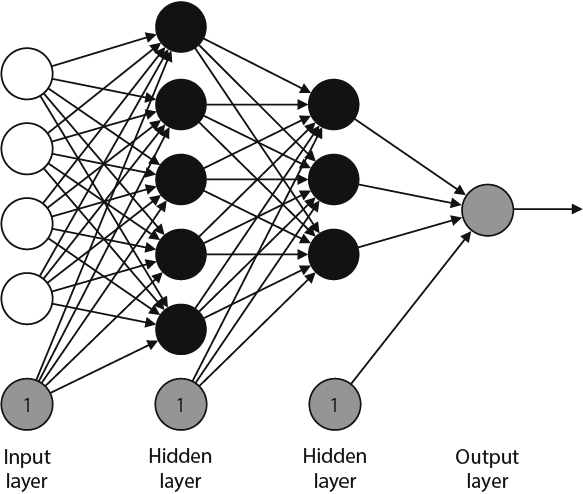
See how each layer connects to the next in a network diagram. section 10.1












