A linear layer is a fully connected transformation that maps a fixed-length input vector to an output vector. Every output unit connects to every input unit, allowing the layer to learn combinations of the input features. section 2.2.4
A position-wise feed-forward network uses one linear layer to expand the vector into a higher-dimensional space, applies a nonlinear activation, and uses another linear layer to restore the original dimension. The same transformation operates independently at each sequence position. section 2.2.4
Two linear layers in a position-wise FFN
class PositionwiseFeedforward(nn.Module): def __init__(self, input_dim, hidden_dim, dropout=0.1): super().__init__() self.dropout = nn.Dropout(dropout) self.fc1 = nn.Linear(input_dim, hidden_dim) self.fc2 = nn.Linear(hidden_dim, input_dim) def forward(self, x): x = self.dropout(torch.relu(self.fc1(x))) return self.fc2(x) Here, fc1 increases representational capacity, while fc2 returns the result to the model's original width. section 2.2.4
Figure 6.4 Linear projection W maps patch vectors from an input space ℝdto an embedding space ℝk. Dashed arrows indicate the mapping of example patches through W.
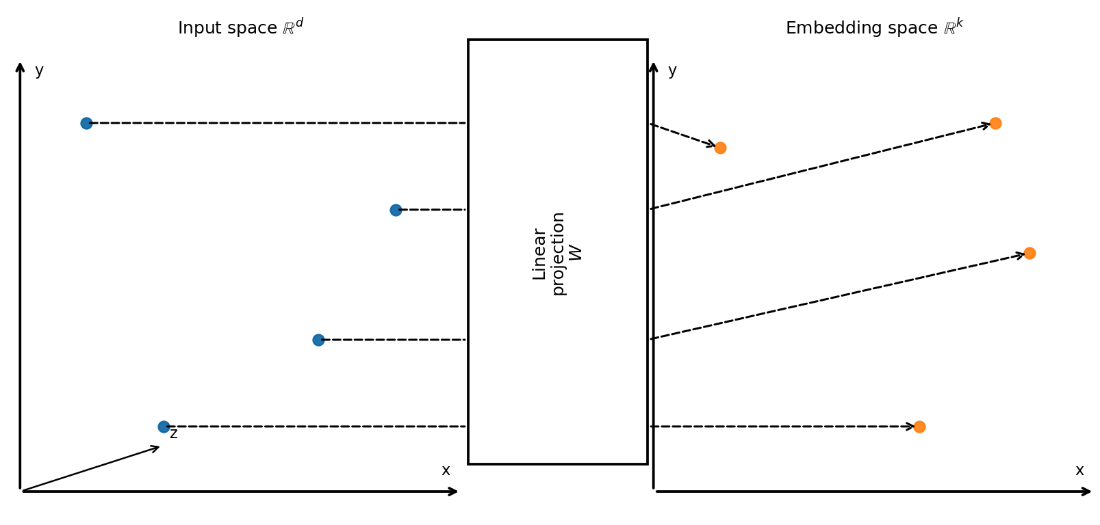
Visualizes a linear projection mapping flattened image-patch vectors from the input space into the transformer's embedding space. section 6.3.1












