A nonlinear mapping transforms aggregated node or edge information through a neural network and activation function. Unlike a purely linear transformation, it lets stacked message-passing layers model more than a linear or logistic regression model. section 3.4.2
A message-passing layer applies the mapping in a short pipeline:
- Aggregate information from neighboring nodes with an order-independent operation such as summation, averaging, or maximum. section 3.4.2
- Pass the aggregated messages through learnable neural-network weights and an activation function to produce embeddings. section 3.4.2
- Combine the transformed embeddings with node or edge data and previous embeddings, then use the resulting representations for prediction or graph embeddings. section 2.4.4
ReLU in a graph neural network
ReLU is a nonlinear mapping that returns the maximum of zero and its input. Applying it after message aggregation prevents a multilayer model from collapsing into an overall linear transformation. section 3.4.2
Figure 2.14 Structure of a multilayer perceptron
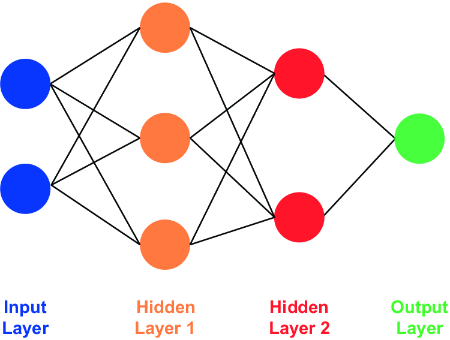
Use the multilayer perceptron diagram to visualize the neural-network transformation applied after graph information is gathered. section 2.4.4






