An object-relational mapper (ORM) lets an application treat relational database tables and their relationships as objects and relationships among objects. Hibernate is one example. section 1.4.4
An ORM can reduce code and make database operations more intuitive when used well. Misuse can slow an application, make code less intuitive, or introduce bugs. section 1.4.4
Choosing a persistence approach
A team maintaining an application with direct JDBC queries considered replacing them with Hibernate. After a proof of concept, it chose Spring's JdbcTemplate instead, aiming to clean up the code without adopting a new framework. section 1.4.4
Figure 14.3 Sometimes apps use frameworks built on top of JDBC, such as Hibernate. The variety in choices makes implementing a persistence layer complex. We want to eliminate this complexity from our apps, and, as you’ll learn, Spring Data helps us do this.
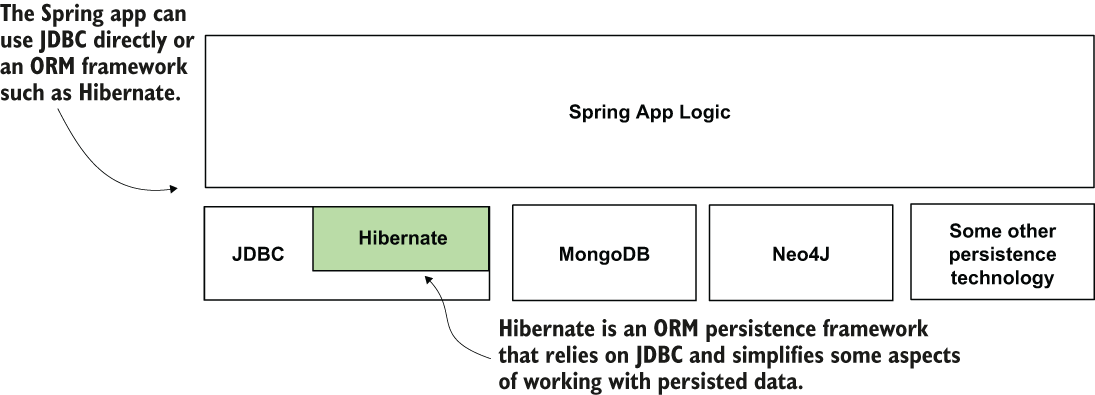
The diagram places Hibernate among frameworks built over JDBC, illustrating one way an application can implement its persistence layer. section 14.1








