liveBook · Manning

Openid connect

As explained in Grokking Software Architecture

An identity layer built on OAuth 2.0 that lets clients verify an authenticated user’s identity and obtain basic profile information.

OpenID Connect (OIDC) handles authentication: it helps verify who a user is. In a token-based identity architecture, an identity provider manages identities and issues verifiable tokens, so applications need not store users’ passwords. section 11.3.2

Passport or valet key?

Think of OIDC as a digital passport that helps prove who you are. OAuth 2.0 is more like a valet key: it concerns what you’re allowed to access. They work together, but answer different questions. section 11.3.2

Figure 11.3 The IdP issues the "Royal Seal" (JWT), which the API Gateway verifies to ensure the user is who they claim to be.
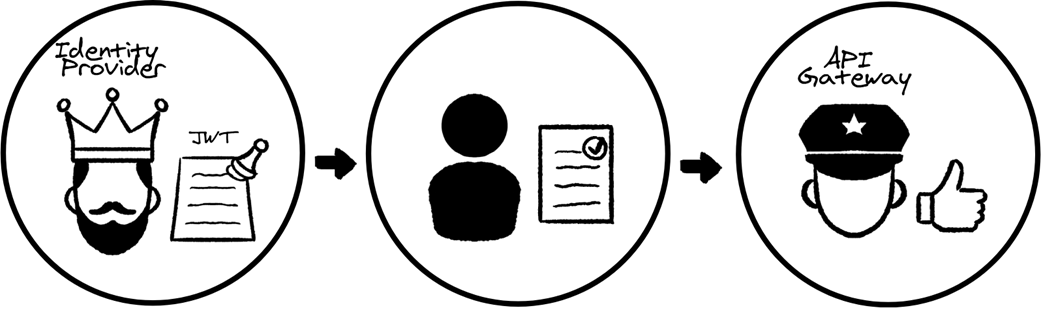
The identity provider issues a JWT, and the API gateway verifies it to check the user’s claimed identity. section 11.3.2


How Grokking Software Architecture covers it

How deep it goes
Defines OIDC’s authentication role and contrasts it with OAuth 2.0, without detailing OIDC protocol mechanics.
Examples
Uses a digital passport for OIDC and a valet key for OAuth 2.0 to distinguish identity from permissions.
What you can do after
Evaluate whether a requirement concerns proving identity or granting access by distinguishing OIDC from OAuth 2.0.
How it connects
Connects identity providers, OAuth 2.0, authentication, authorization, and JWT verification at an API gateway.

Also explained in

Compare how 14 books explain openid connect →

Related concepts

This explainer was generated by Manning's knowledge graph from the text of Grokking Software Architecture. The section links point to the parts of the book it draws on.











