Operations research turns real-world business decisions into mathematical models to help decision-makers choose well. A typical formulation defines decision variables, an objective to optimize, and constraints that represent limits or rules. section 1.6.1
Choose a model type based on the relationships and decisions in the problem:
- Linear programming uses linear objectives and constraints. section 1.6.1
- Mixed integer programming keeps linear relationships but requires some variables to be integers. section 1.6.1
- Nonlinear programming applies when the objective or constraints are nonlinear. section 1.6.1
A bakery’s production decision
A bakery chooses how many chocolate and vanilla cakes to make to maximize profit, subject to labor and flour limits. Cake quantities are the decision variables; available resources become constraints. section 1.6.1
Figure 1.6 Linear programming formulation of bakery shop problem.
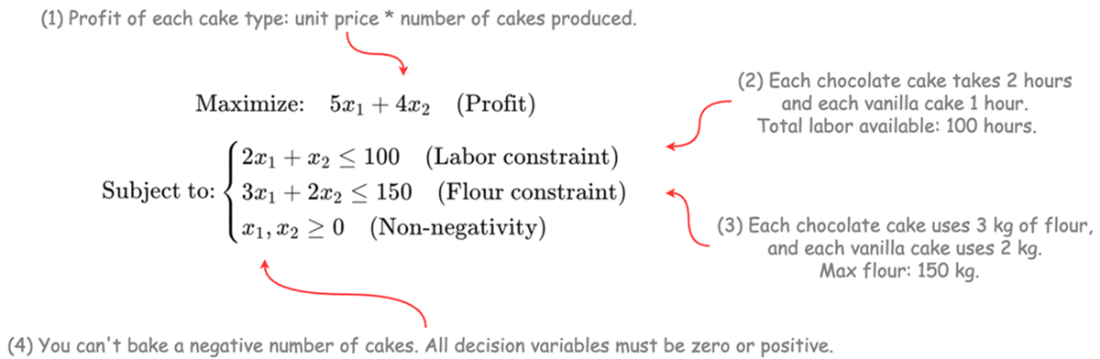
See the bakery example expressed as a linear-programming formulation. section 1.6.1


