An output space is the geometric space containing model outputs. A model maps each point in the input feature space to a point here, ideally making classification or estimation easier. Output spaces often have fewer dimensions than input spaces; for classification, points from different classes should form separate clusters. section 1.4
Geometrically, the model transforms a difficult arrangement of input points into one that is easier to separate. A complex task may require nonlinear functions or layered combinations of simpler machines to create a useful mapping. section 1.4 section 1.8
From threat features to an output score
In the cat brain example, hardness and sharpness form a two-dimensional feature space. The model maps each input point to a one-dimensional threat score, approximated by its signed distance from x0 + x1 = 1: y = (a + b - 1) / √2. The sign indicates which side of the separator the point occupies. section 1.4
Figure 1.3 A model maps the points from input (feature) space to an output space where it is easier to separate the classes. For instance, in this figure, input feature points belonging to two classes, red (+) and green (–) are distributed over the volume of a cylinder in a 3D feature space. The model unfurls the cylinder into a rectangle. The feature points are mapped onto a 2D planar output space where the two classes can be discriminated with a simple linear separator.
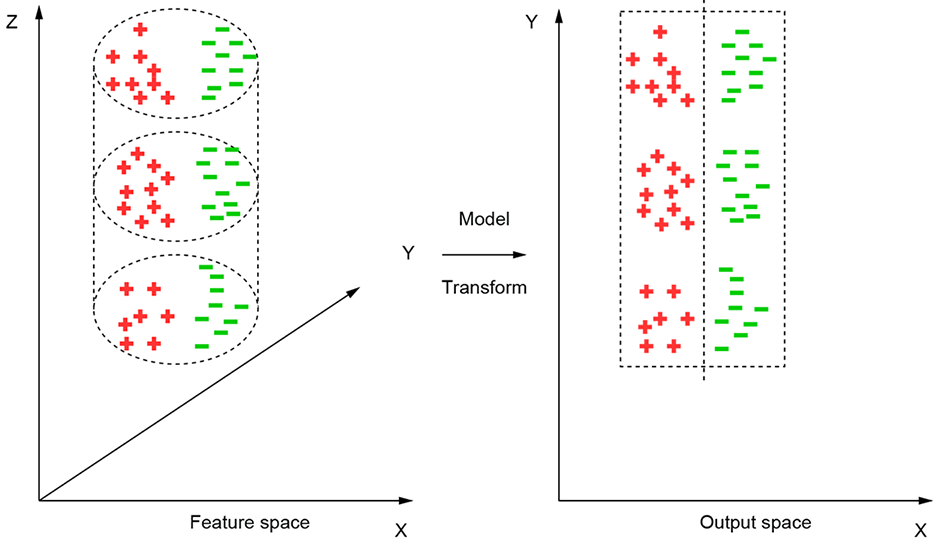
Visualize output-space construction as a cylinder of three-dimensional feature points unfurled into a rectangle, where a simple linear separator distinguishes the classes. section 1.4
