P95 latency is the response-time value at or below which 95% of measured requests complete; the slowest 5% take longer. It reveals intermittent slowness that averages can hide. section 12.3.3
Use P95 latency to investigate:
- Timeout mismatches, especially when P95 approaches or exceeds the client timeout. section 12.3.3
- Load-related slowdowns, exhausted thread pools, slower database queries, resource starvation, and GC delays. section 12.3.3
- Deployment regressions affecting complex requests or other intermittent failure patterns. section 12.3.3
A two-second timeout
Suppose a client timeout is 2,000 ms while downstream P95 latency is 2.5 seconds. The average may look acceptable, but roughly 5% of requests exceed the timeout, causing client errors even when the server eventually completes processing. Compare client-request duration with server-processing time in traces or logs. section 12.3.3
Figure 12.9 Identifying timeout mismatches using percentiles. P95 and P99 latencies approach or exceed the 2000 ms timeout threshold, revealing that some requests are likely to fail—despite the service working as expected.
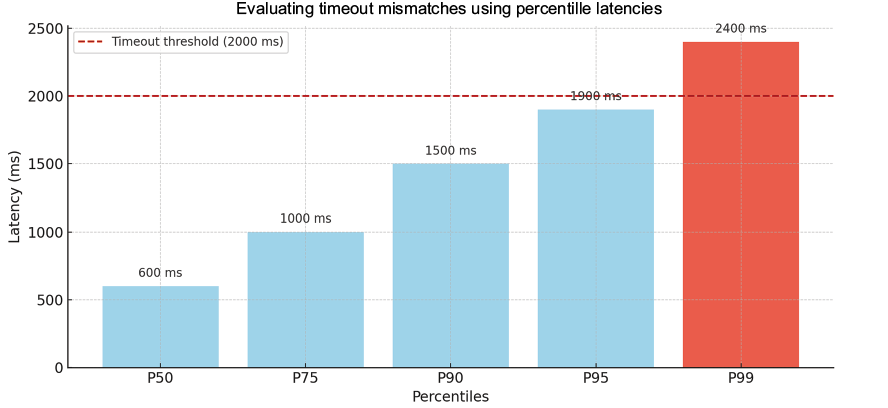
Use the percentile comparison to see how P95 and P99 approach or exceed the 2,000 ms timeout threshold. section 12.3.3






