liveBook · Manning

Parametric knowledge

As explained in Context Engineering

Parametric memory is knowledge embedded in a model’s parameters through training.

Parametric knowledge is information embedded in an LLM’s parameters through training. It includes general facts, language patterns, and reasoning heuristics, and is accessed implicitly during inference. section 5.1

Unlike non-parametric memory, parametric knowledge is static and difficult to update. Agent systems keep user-specific or evolving information outside the model and inject retrieved entries into context when needed. section 1.5.4 section 5.1

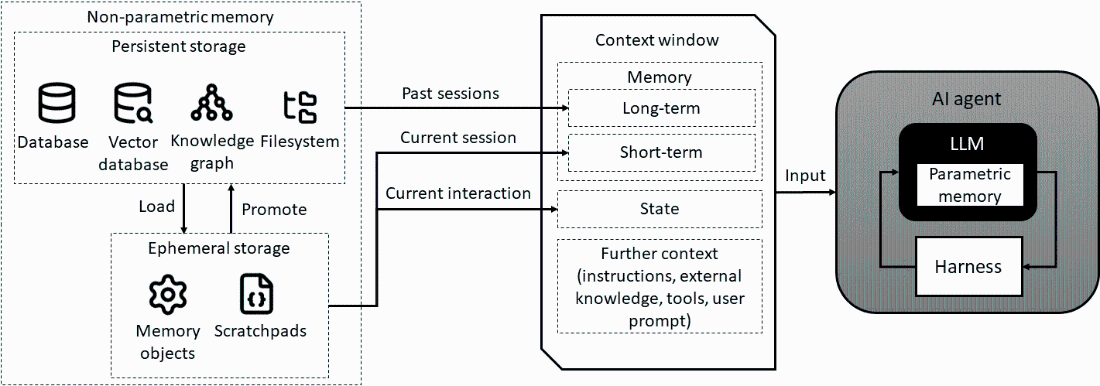
Figure 5.1 Memory in an AI agent: parametric memory inside the model, and non-parametric memory kept in persistent and ephemeral storage, surfaced in the context window as long-term memory, short-term memory, and state
memory v9

Shows parametric memory inside the model alongside external storage and the memory surfaced in an agent’s context window. section 5.1


How Context Engineering covers it

How deep it goes
Defines where it resides and what it contains, but does not explain how training encodes it.
Examples
Illustrates its contents through general facts, language patterns, and reasoning heuristics.
What you can do after
Understand how model-internal knowledge differs from externally managed memory in agent systems.
How it connects
Contrasts with non-parametric memory, which stores runtime-updatable information outside the model and injects selected entries into context.

Also explained in

Compare how 3 books explain parametric knowledge →

Related concepts

This explainer was generated by Manning's knowledge graph from the text of Context Engineering. The section links point to the parts of the book it draws on.
