Parametric knowledge is information, facts, and patterns learned during training and stored in a neural network’s weights and parameters. It contrasts with context memory, which is supplied during inference. In production systems such as RAG, retrieved documents provide grounding, while additional claims may come from parametric knowledge. section 5.1.1
Use the distinction when evaluating generated claims:
- Separate source-grounded claims from claims generated from the model’s learned parameters. section 5.1.1
- Route source-based claims to reference verification and open-domain claims to consistency-based checks such as SelfCheckGPT. section 5.1.1
- Treat repeated agreement as evidence of stable learned knowledge, not proof of factual correctness. section 5.2.1
Stable and unstable recall
Repeatedly asking for the author of the 2020 paper “GLU Variants Improve Transformer” produces the stable answer Noam Shazeer. Asking about a less reliably known sparse-mixture-of-experts paper may produce different co-author lists across generations, suggesting plausible construction rather than stable parametric knowledge. section 5.2.1
Figure 5.2 A production hallucination detection pipeline. Generated responses are decomposed into claims, routed to the appropriate verifier, aggregated into response-level metrics, and converted into actions such as logging, review, regeneration, or blocking.
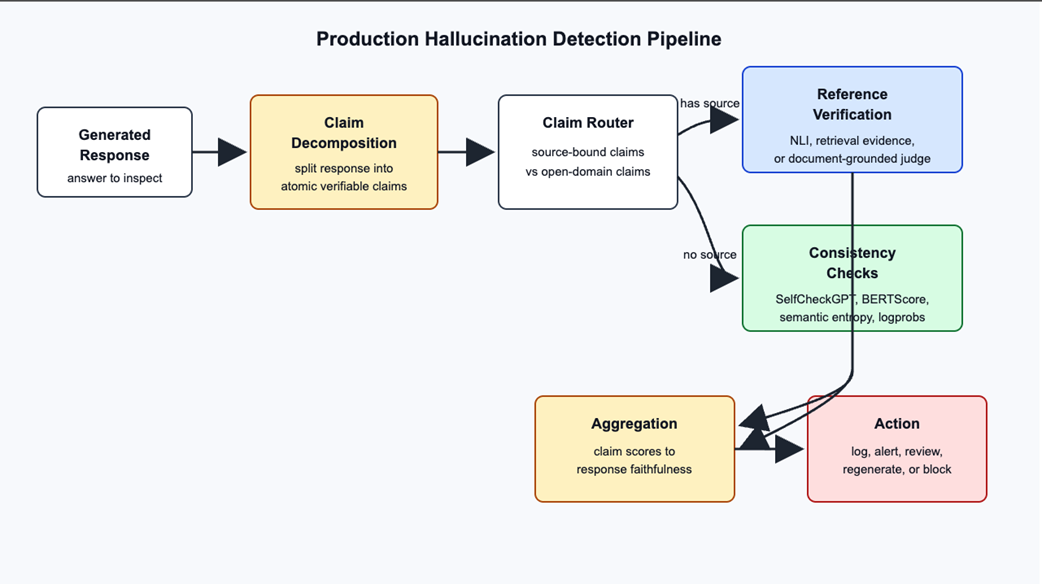
Trace how generated responses are decomposed into claims, routed to source-based or consistency-based verifiers, aggregated into faithfulness metrics, and linked to production actions. section 5.1.1


