A Pareto frontier is the boundary of candidate models with the best available tradeoffs across multiple tests. It helps combine independent measures without forcing them into one aggregate ranking. A model is excluded when another is at least as good across the compared dimensions and better in one of them. section 8.3.3
Comparing hbi and rotm performance
For imaginary models evaluated on the hard-but-important (hbi) and run-of-the-mill (rotm) test sets, model F remains in the Pareto set because it offers a best tradeoff. Model G is excluded because it is no better than F on either test. The resulting candidate set narrows the decision but does not determine the final choice. section 8.3.3
Figure 8.3 A Pareto front for models evaluated from the hard-but-important (hbi) and run-of-the-mill (rotm) data sets
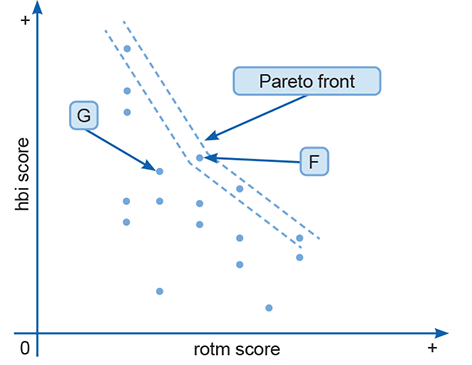
Use the figure to inspect the Pareto-front boundary for models evaluated across hbi and rotm. section 8.3.3
Pareto sets can handle more than two tests, but they usually leave several candidates for qualitative judgment. Record the decision basis when selecting among remaining models, especially when quantitative results do not identify a clear winner. section 8.6


