Pattern matching completes text or answers from learned correlations and recurring examples. A conventional LLM generates continuations that fit training patterns rather than representing premises and applying formal rules. section 1.4
Distinguish association-based completion from logical reasoning through two cases:
- “The capital of Germany is…” → “Berlin” reflects a strong learned association, not a deduction. section 1.4
- “All birds can fly; a penguin is a bird” yields “A penguin can fly” in a closed-world prompt, while background knowledge exposes a contradiction in an open-world setting. section 1.4
Association versus reasoning
Pattern matching can produce a correct answer without showing how it was obtained. Logical reasoning instead uses intermediate steps, formal relationships, implications, and contradiction recognition. section 1.4 section 1.1
Figure 1.6 Contradictory premises lead to a logical inconsistency. From “All birds can fly” and “A penguin is a bird,” we infer “A penguin can fly.” This conclusion conflicts with the established fact “A penguin cannot fly,” which results in a contradiction.
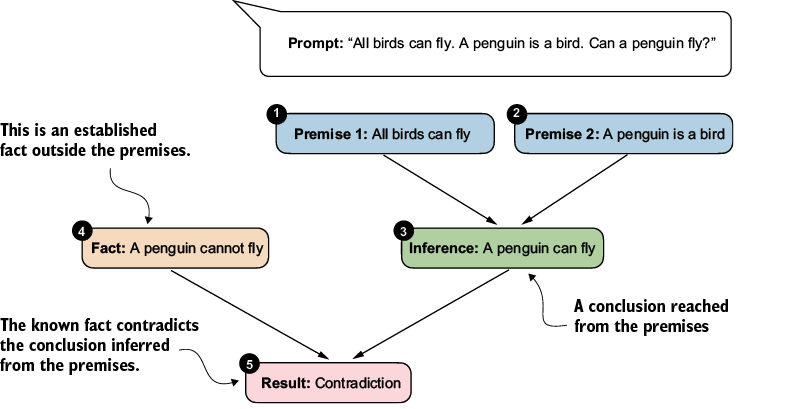
Trace how two premises produce a conclusion that conflicts with established background knowledge, making the limit of pattern matching visible. section 1.4


