liveBook · Manning

Pattern recognition

As explained in Data Without Labels

Pattern identification is the process of discovering recurring structure or regularity in data.

Pattern recognition identifies recurring structure or regularity in data, helping machine learning interpret complex inputs such as images, text, audio, video, and sensor datasets. section 1.3

Without a target variable, unsupervised learning discovers patterns from input data alone, revealing structure for exploration, segmentation, and anomaly detection. section 1.5.2

Practical uses include:

  • Grouping customers by attributes such as revenue, visit frequency, recency, age, and demographics to support targeted segmentation. section 1.5.2
  • Finding unusual network activity by identifying outliers in historical data. section 1.5.2
  • Examining medical image data for underlying factors that may support differentiated treatment. section 1.5.2
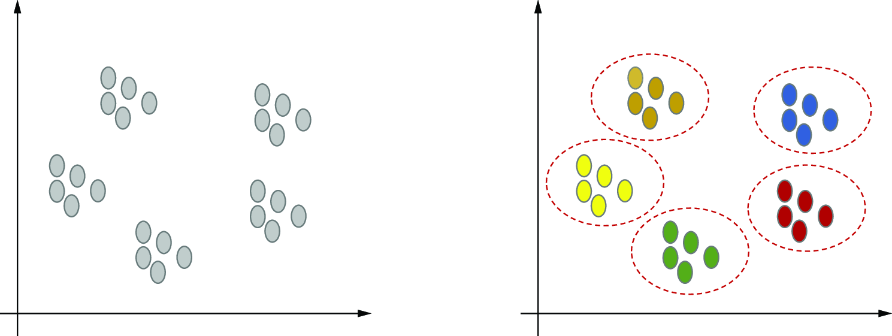
Figure 1.16 An unsupervised learning algorithm finds patterns in the data on the left and results in clusters on the right.
figure

Compare raw data points with the clusters produced when an unsupervised algorithm discovers structure. section 1.5.2


How Data Without Labels covers it

How deep it goes
Defines pattern discovery and illustrates clustering and applications, but stops short of algorithmic implementation or mathematical detail.
Examples
Uses shape grouping, customer clusters, network outliers, medical images, and complex media or sensor data as examples.
What you can do after
Evaluate/understand how recurring structure can reveal segments, outliers, and insights when target labels are unavailable.
How it connects
Connects machine learning with unsupervised learning, clustering, segmentation, anomaly detection, and exploratory data analysis.

Also explained in

Compare how 3 books explain pattern recognition →

Related concepts

This explainer was generated by Manning's knowledge graph from the text of Data Without Labels. The section links point to the parts of the book it draws on.
