liveBook · Manning

Perceptron

As explained in Fight Fraud with Machine Learning

A perceptron is a single-layer neural model that computes a weighted sum of inputs and applies an activation function to produce an output.

A perceptron is a single-layer neural model with one neuron. It multiplies each input by a weight, sums the results, and passes the sum through a step function to produce a binary output. section 4.1.1

The perceptron establishes core ideas later extended by deep neural networks:

  • Weights represent the relative importance of incoming inputs. section 4.1.1
  • The step function acts as an early activation function; later models use functions such as Sigmoid, TanH, and ReLU. section 4.1.1
  • Adding hidden layers increases depth and enables intermediate representations, while nonlinearity supports complex patterns and decision boundaries. section 4.1.1
Figure 4.3 The perceptron model developed in 1943, inspired by the structure of human neurons.
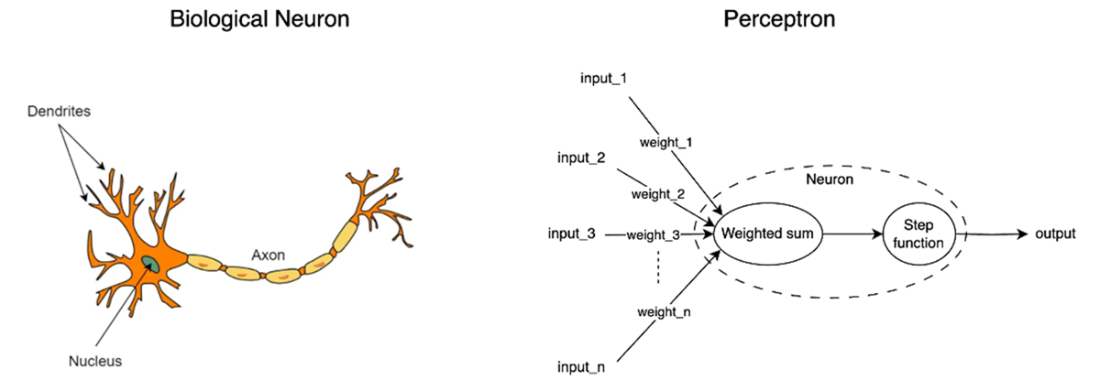
Use the diagram to relate the perceptron’s weighted inputs, single neuron, activation step, and binary output to the human-neuron analogy. section 4.1.1


How Fight Fraud with Machine Learning covers it

How deep it goes
Defines the weighted-sum and step-function computation, then stops before training procedures or implementation details.
Examples
Uses a human-neuron comparison and a diagram showing weighted inputs, a single neuron, and binary output.
What you can do after
Evaluate how weighted sums and activation functions form the basic computation of a neural model.
How it connects
Connects the perceptron to neurons, activation functions, hidden layers, and deep neural networks.

Also explained in

Compare how 7 books explain perceptron →

Related concepts

This explainer was generated by Manning's knowledge graph from the text of Fight Fraud with Machine Learning. The section links point to the parts of the book it draws on.




