A physical model represents how real-world mechanisms produce outcomes under specified conditions. It matters when a decision changes those conditions: a predictive pattern may work for tomorrow, yet fail after an intervention or in an unfamiliar setting. Ask whether the goal is merely to predict what usually happens or to forecast what will happen after the world is changed. section 4.1.3
Physical models are useful when:
- Historical regularities are not enough, such as predicting sunrise on Mars rather than repeating yesterday’s Earth observation. section 4.1.3
- Decisions involve interventions, such as rerouting traffic, closing lanes, or adding hospital resources. section 3.3.3
- Unobserved scenarios must be explored by representing mechanisms and generating outcomes under different conditions. section 3.3.3
Traffic as a simplified physical model
A detailed traffic simulator represents signals, car types, and driver behavior. A causal model can simplify the same problem by learning from existing data and treating traffic policies as interventions. Detectors provide flow, the number of cars passing in an hour, and occupancy, the share of time a detector is covered. Flow alone is ambiguous: low flow may mean light traffic or a traffic jam; occupancy helps distinguish them. section 3.3.3
Figure 3.17 Description of traffic behavior unfolded in time
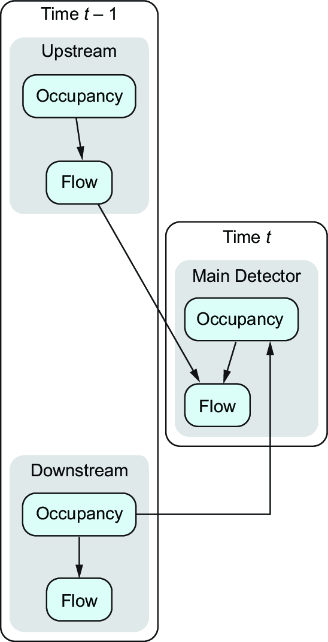
Use the time-unfolded traffic diagram to connect detector measurements, traffic flow, congestion, and changing system states. section 3.3.3

