The point at infinity, written 0, is the special identity element for elliptic-curve point addition. It is not an ordinary point on the curve, but it behaves like numeric zero: P + 0 = P and P - P = 0. This gives elliptic-curve points the identity needed for group arithmetic. section 3.1
For ordinary curves written as y² = x³ + a₄x + a₆, the implementation represents 0 as (0, 0). With the curves considered here, a₆ is nonzero, so y cannot be 0 for an ordinary curve point; the coordinate pair is therefore easy to recognize as the special case rather than a valid point. section 3.1.1
Figure 3.1 Elliptic curve \(y^2=x^3-5 x +5\)
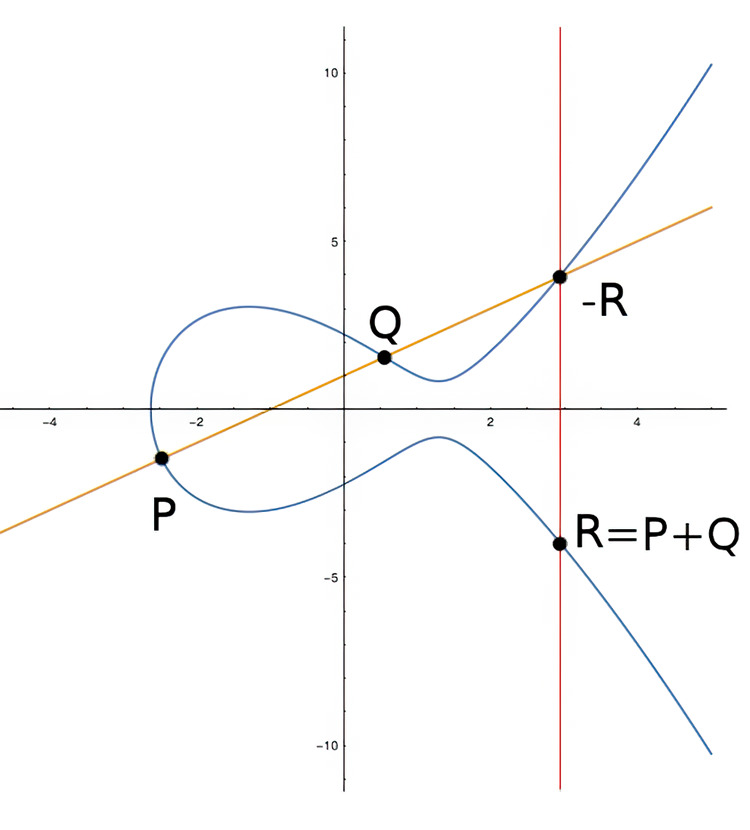
The curve diagram motivates the identity: adding a point R to its inverse −R follows a vertical line and yields 0 rather than another plotted curve point. section 3.1
Point-addition code must handle 0 before applying slope formulas:
- If either input is 0, copy the other input directly to the result. section 3.2.2
- If two inputs have equal x coordinates and opposite y coordinates, return (0, 0); computing a slope would otherwise divide by zero. section 3.2.2
- Check for 0 both as an input and as a possible output, since point multiplication reuses point addition for doubling and adding. section 3.6
Repeatedly adding P eventually reaches 0. If mP = 0, then P has order m; the points of order m form the m-torsion subgroup. Group size counts the point at infinity even though it is not among the ordinary coordinate points listed on the curve. section 3.1.4 section 13.3.2
Tiny group count
A tiny extension-curve example lists 54 ordinary points in G₁ but gives the group order as 55, because the point at infinity supplies the additional identity element. The example then selects points of prime order 11 as base points. section 13.3.2
Pairing routines also treat the point at infinity as an explicit exceptional input. Nondegeneracy defines a pairing with 0 as 1, preventing division by zero; the hP,Q routine implements this by returning the constant polynomial value 1 immediately when either input is 0. section 15.1.2 section 15.3