liveBook · Manning

Point at infinity

As explained in Real-World Cryptography

The point at infinity is an added formal point that serves as the identity element of an elliptic curve group.

The point at infinity is an invented point, usually written O, that makes elliptic-curve addition work in special cases. It acts like zero: O + O = O, and P + O = P for every point P on the curve. section 5.3.1

Geometrically, it appears when the line or tangent used for addition does not meet the curve at another ordinary point, including cases where two points cancel. Adding it completes the group structure used by elliptic-curve cryptography. section 5.3.1

Figure 5.10 Building on figure 5.9, addition on an elliptic curve is also defined when adding a point to itself or when two points cancel each other to result in the point at infinity (O).
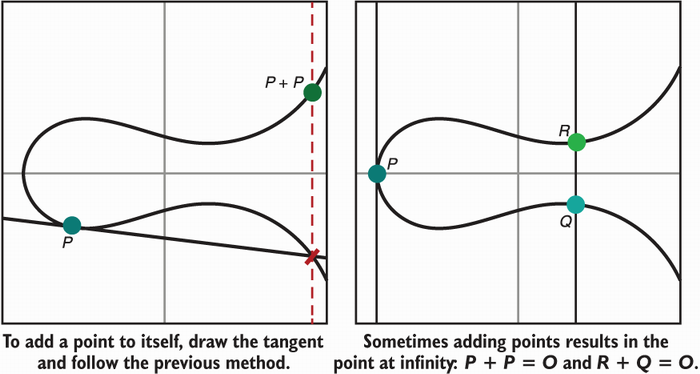
Use the figure to see point doubling and cancellation cases that produce O. section 5.3.1

In elliptic-curve key exchanges, O also matters as a validation check:

  • Reject a received public key if it is the point at infinity. section 5.4
  • Check that the received coordinates describe a point on the defined curve before scalar multiplication. section 5.4


How Real-World Cryptography covers it

How deep it goes
Defines the point geometrically and algebraically, then applies it to public-key validation without detailing implementation internals.
Examples
Uses O + O = O, P + O = P, geometric cancellation, and public-key rejection checks as concrete examples.
What it assumes
Assumes basic elliptic-curve points and addition while introducing the identity element needed to form a group.
What you can do after
Diagnose invalid elliptic-curve public keys by checking for O and verifying coordinates against the curve equation.
How it connects
Connects elliptic-curve addition, group identity, elliptic-curve cryptography, scalar multiplication, ECDH, and invalid curve attacks.

Also explained in

Compare how 3 books explain point at infinity →

Related concepts

This explainer was generated by Manning's knowledge graph from the text of Real-World Cryptography. The section links point to the parts of the book it draws on.
