A point at infinity extends Euclidean space with a limiting location beyond every finite distance. In homogeneous coordinates, it has zero scale: (xₚ, yₚ, 0). It cannot be converted to Euclidean coordinates because division by wₚ is undefined. section 4.3.1
The idea becomes intuitive by shrinking the homogeneous scale while holding the other coordinates fixed. As wₚ approaches zero, the corresponding Euclidean point moves farther from the origin without reaching a finite endpoint. The zero-scale limit represents the direction or infinitely far location reached by that process. section 4.3.1
Key properties:
- Euclidean points require wₚ ≠ 0, because conversion uses xₑ = xₚ/wₚ and yₑ = yₚ/wₚ. section 4.3.1
- All points with wₚ = 0 form a belt that complements Euclidean space in projective space. section 4.3.1
- These points make projective computations easier, including transformations represented through matrix multiplication. section 4.3.1 section 4.7
Following a point toward infinity
The homogeneous point (1, 0, 1) represents the Euclidean point (1, 0). Keeping xₚ = 1 and reducing wₚ produces (10, 0), (100, 0), (1000, 0), and so on. The limiting homogeneous form (1, 0, 0) lies in projective space rather than Euclidean space. section 4.3.1
Figure 4.16 An example of central projection. Projection lines intersect in the center of the projection.
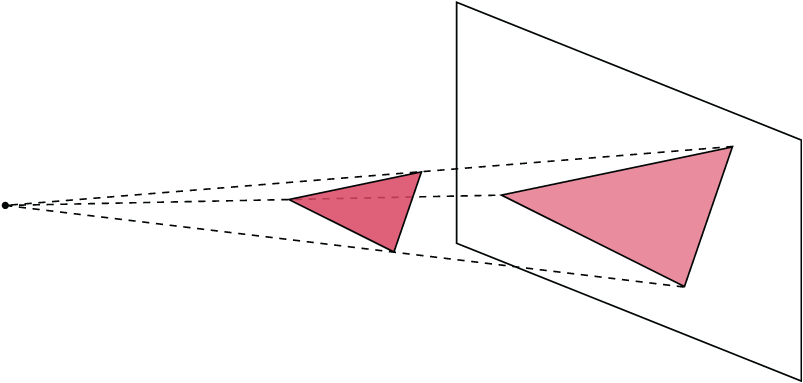
Use the central-projection figure to connect ordinary finite projection geometry with projective representations. section 4.3.1
Figure 4.17 An example of parallel projection. In projective space, this example is the same as figure 4.16.
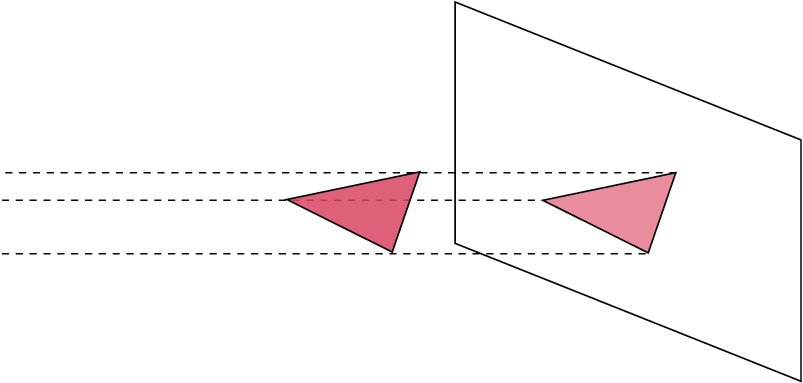
Compare parallel projection with central projection: projective space represents both through the same underlying projective setup. section 4.3.1


