A policy engine evaluates an autonomous agent’s intended action against enterprise rules before execution. In milliseconds, it keeps delegated authority inside an enforceable decision boundary rather than relying on episodic review. section 2.2.1
Treat the policy engine as part of a runtime governance loop:
- Constrain the agent with an autonomy boundary defining hard limits and soft thresholds. section 2.2.1
- Observe decision behavior through signals such as boundary proximity, confidence stability, and behavioral drift. section 2.2.1
- Evaluate each intended action against policy before execution, then escalate when authority exceeds the permitted scope. section 2.2.1
Runtime supervision
An agent operates within an autonomous decision space. Observability sensors detect drift, the policy engine evaluates intended actions, and the autonomy boundary constrains what may proceed. When conditions exceed the permitted scope, an escalation trigger returns authority to a human with sufficient context to act. section 2.4
Figure 2.2 Architecture as runtime supervision. The diagram shows four components working as a continuous control loop. Observability sensors detect drift in the agent's behavior. The autonomous decision space is where agent actions occur, constrained by the autonomy boundary. The governance engine evaluates policy against intended actions before those actions execute and adjusts the decision space over time as conditions change. Together, these components supervise delegated authority rather than intervening in individual decisions.
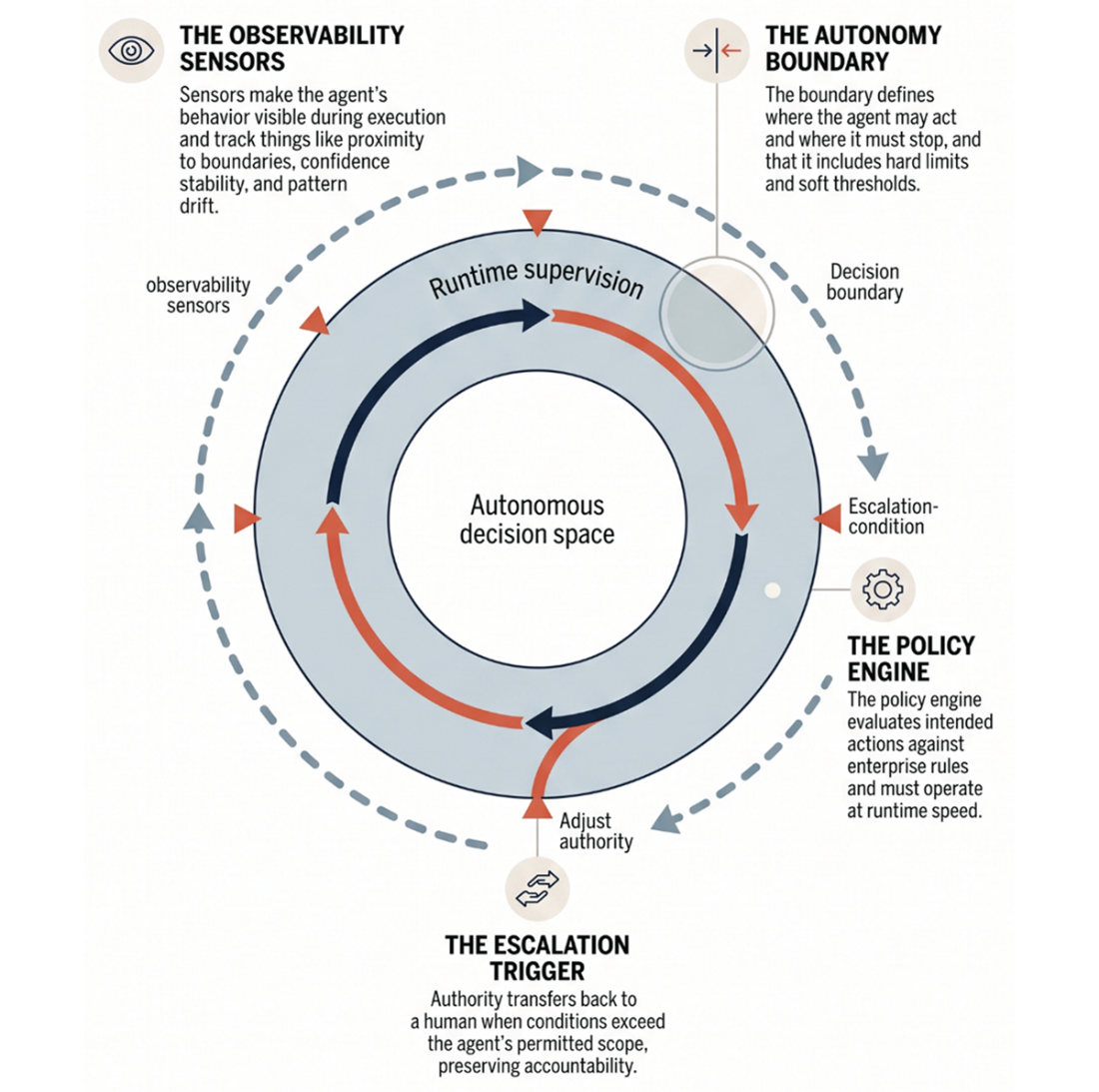
Use the control-loop diagram to see how policy evaluation, observability, autonomy boundaries, and changing delegated authority work together. section 2.2.1



