A position vector represents a point by conventionally starting the vector at the origin. The vector keeps its direction and length, while its coordinates identify the point it reaches. This convention connects vector arithmetic with geometric operations. section 9.1 section 2.1.2
Use a position vector to:
- Write a point as a coordinate tuple, such as (0.5, 1.5) in 2D or (0.5, 1.5, 0.0) in 3D. section 2.1.2
- Express the same vector as scaled basis vectors, such as (0.5, 1.5) = 0.5i + 1.5j. section 2.1.2
- Translate a model by adding one vector to all its point vectors, or scale it by multiplying them by a scalar. section 9.1
A point vector in practice
Treating a vector toward (0.5, 1.5) as a position vector lets that coordinate describe a point while retaining vector operations such as addition and scalar multiplication. section 2.1.2
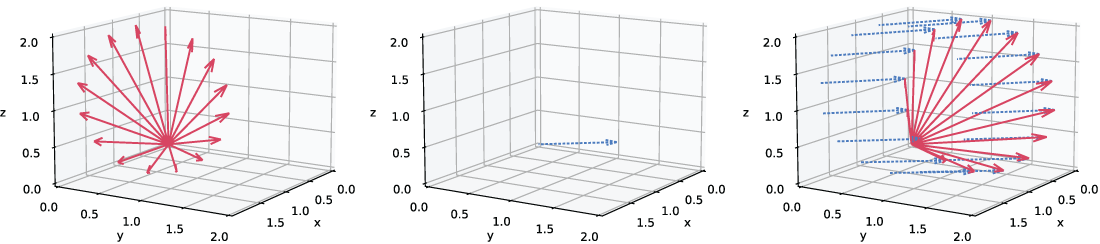
Shows how adding the same vector to every point vector translates a geometric model. section 9.1


