A position vector encodes a particle’s candidate solution as a permutation. In permutation-based particle swarm optimization, it can represent an ordering such as the sequence of cities in a traveling salesman problem. section 9.4
An eight-city route
The permutation [2, 4, 6, 1, 5, 3, 8, 7] represents one candidate route through eight cities. A particle’s velocity is a sequence of swaps, and applying those swaps to the position vector produces a new candidate solution. section 9.4
Permutation-based PSO redefines the usual vector operations:
- Multiplication changes a velocity’s number of swaps: zero removes them, values below one truncate them, and values above one augment them. section 9.4
- Subtraction compares two position vectors and returns swaps that can transform one permutation into the other. section 9.4
- Addition applies a velocity’s swaps to a position vector, generating a new permutation and candidate solution. section 9.4
Figure 9.9 Redefined subtraction operation for permutation-based PSO
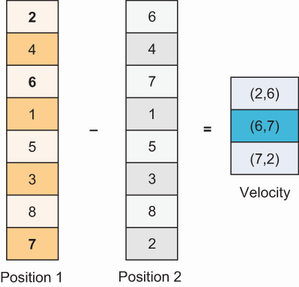
Trace how subtracting two permutations produces the swap sequence used as a discrete velocity. section 9.4
Figure 9.10 Redefined addition operation for permutation-based PSO
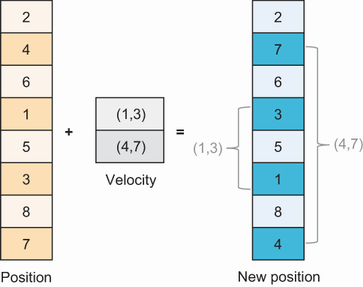
Follow how applying a swap velocity to a position vector generates the next candidate permutation. section 9.4


