A primary color is a fundamental component of a color system, but the set depends on what is being mixed. Light uses an additive model; paint and ink use a subtractive model. section 4.1 section 4.0
The two practical sets are:
- Red, green, and blue are the primary colors of light. Combining all three produces white light; combining pairs produces yellow, magenta, or cyan. section 4.1.2
- Cyan, magenta, and yellow are the primary colors of the subtractive model used for paint, ink, and similar physical media. section 4.5
- RGB is especially important for visualizations because computer monitors use it, and RGB values can also be written as hexadecimal triplets. section 4.5
Three colored flashlights
Shine red, green, and blue lights together: overlapping pairs show yellow, magenta, and cyan, while the central overlap becomes white. The demonstration makes additive mixing visible rather than merely theoretical. section 4.1.2
Figure 4.5 To prove to myself and to you that red, green, and blue are truly the primary colors of light, I had a little photo shoot with my new set of colored flashlights. Around the outside, you can see the primary colors, and then inside, where two overlap, you can see the secondary colors. Finally, in the center where all three lights overlap, you can see the white light. Nifty!
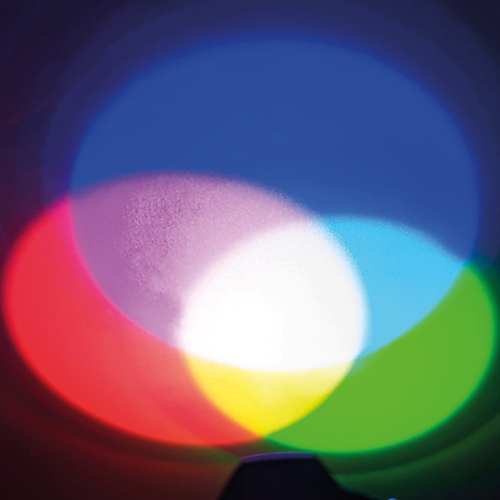
Use the flashlight photograph to inspect the three light primaries, their secondary-color overlaps, and the white center. section 4.1.2

