A probabilistic system can produce varying outputs rather than a fixed answer for identical inputs. In AI-assisted engineering, that variability matters most when a fluent answer looks reliable enough to implement without checking—especially for a consequential rule such as a payment rule. section 1.3
Language models predict likely next tokens, not objective facts. They have no built-in model of truth, so correctness must be checked against a standard outside the model. Adding retrieval can improve factuality, but it also adds complexity and failure surface. section 1.3
Configuration choices trade off several goals; no single configuration maximizes them all:
- Accuracy measures correctness against an external standard. Creativity helps explore designs but can be dangerous when implementing strict rules. section 1.3
- Safety includes both refusals and limits on what the system can do, such as resistance to injection and limits on tool-use blast radius. section 1.3
- Cost includes tokens, retries, human review, and incidents. Latency matters because a slow verification loop may stop being run. section 1.3
Generated code can accelerate scaffolding and familiar patterns while leaving difficult edge cases and integration decisions unresolved. Locally correct components can still violate project conventions or fail at their seams. Review the boundaries and the larger architecture, not just the happy path. section 1.6
Figure 1.1 The vibe engineering loop carries a feature from open-ended exploration through an executable specification and an iterating verification gate to tested, team-owned code.
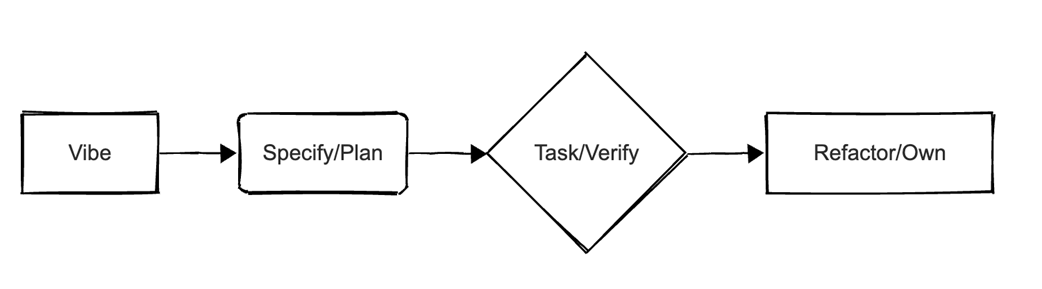
The engineering loop moves from open-ended exploration to an executable specification and an iterative verification gate, ending with tested, team-owned code. section 1.3

