A producer originates data at one end of a stream pipeline. It may read a file, receive an HTTP request or response, or query a database; data may arrive all at once or in increments. Zero or more transforms can modify the flow before a consumer receives it. section 10.1
Reason about a producer through its flow-control model:
- Push makes the producer initiate flow and the consumer react; it is generally eager, although pacing remains possible. section 10.1
- Pull makes the consumer request data; the producer waits for demand and is generally lazy, although it may work ahead. section 10.1
- The streamed value can be bytes, objects, strings, or numbers; the producer role does not depend on the data type. section 10.1
- Async iterables and Web Streams use pull-oriented flow, while Node.js Streams are mostly push-oriented; their backpressure signals and enforcement differ. section 10.2
Figure 10.1 The fundamental flow of data through a stream is the same regardless of the specific implementation. A producer provides chunks of data that flow through a series of transforms and on to a consumer.
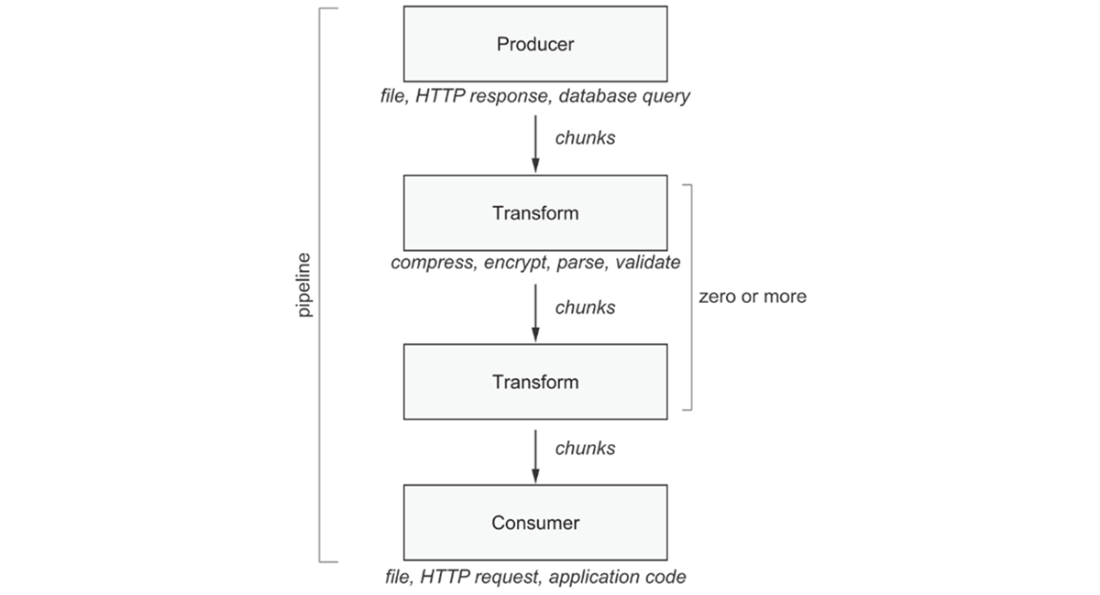
Trace chunks from the producer through transforms to the consumer. section 10.1
Table 10.1 The three streaming models compared
|
|
Async Iterables
|
Web Streams
|
Node.js Streams
|
|
Specification
|
ECMAScript Language Specification
|
WHATWG Streams Standard
|
None (implementation defined)
|
|
Data flow
|
Pull (consumer initiates)
|
Pull (consumer initiates)
|
Mostly Push (producer initiates)
|
|
Architecture
|
Async iteration protocol
|
Promises
|
EventEmitter
|
|
Core types
|
AsyncIterator, AsyncGenerator
|
ReadableStream, WritableStream, TransformStream
|
Readable, Writable, Transform
|
|
Backpressure Signal (“the bucket is almost overflowing!”)
|
Implicit: next() not called
|
writer.ready promise and desiredSize
|
push/write methods return false
|
|
Backpressure policy
|
next() called when ready
|
writer.ready promise and desiredSize
|
'drain' event
|
|
Enforcement
|
Structural (no bypass mechanism)
|
Structural via pull, but by-passable via extracted controller
|
Advisory (producer can ignore)
|
|
Internal storage
|
No chunk queue; suspended generator state only
|
Hidden buffer
|
Hidden buffer
|
|
highWaterMark default (how much data can the buffer hold)
|
N/A
|
1 (CountQueuingStrategy)
|
16 KB (binary), 16 objects (object mode)
|
|
Piping API
|
N/A (use for-await-of)
|
pipeTo(), pipeThrough()
|
pipe(), stream.pipeline()
|
|
Error propagation
|
Thrown exceptions try/catch around for-await-of
|
Promise rejection
|
Error events, manual in pipe, automatic in pipeline
|
|
Async iteration
|
|
Web Streams
|
Supported (for
await…of)
|
|
Per-chunk overhead
|
|
WHATWG Streams Standard
|
Minimal (event emission)
|
Compare producer behavior, flow direction, backpressure signals, and enforcement across async iterables, Web Streams, and Node.js Streams. section 10.2









