Business value is the measurable business effect an initiative or product is expected to create, such as revenue, customer retention, money, data, productivity, or lower operating costs. It connects technical and architectural decisions to outcomes that matter to customers, the organization, and its strategy. section 6.1.3 section 1.1
Assess business value by asking what outcome is created and for whom:
- Customer value can include improved productivity or increased sales. section 6.1.3
- Business value can include money and data, while internal products may create productivity gains or reduce operating costs. section 6.1.3
- Value should be balanced with quality, speed of learning, safety, governance, risk, security, compliance, and people’s experience. section 1.1
Choosing strategic IT
An architecture modernization proposal becomes more credible when its technical change is connected to differentiation and measurable business impact. Wardley Mapping can identify candidate areas, but each candidate still requires detailed examination of how it contributes to strategy; commodity capabilities are less likely to offer differentiation. section 10.1.2 section 2.1.6
Figure 1.3 Better Value Sooner Safer Happier. (Source: Smart et al., Sooner Safer Happier: Antipatterns and Patterns for Business Agility [Portland, OR: IT Revolution 2020])
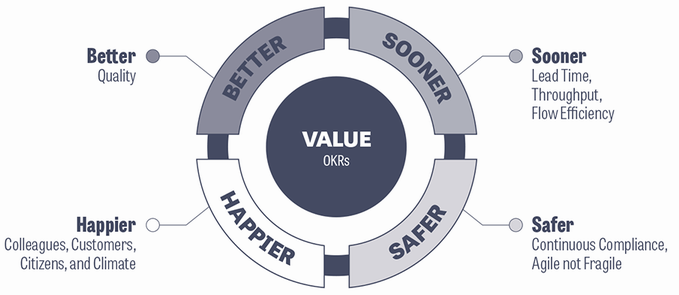
Use the BVSSH model to compare how a decision affects value alongside quality, speed, safety, and stakeholder experience. section 1.1





