What is the probability of drawing an ace and then a king without replacing the first card? The multiplication rule answers such questions by combining the probability of one event with the conditional probability of another. It applies to events occurring together as well as to events in sequence. section 2.3.4
P(A∩B) is the probability that both events occur. P(A) is the probability of A, and P(B | A) is the probability of B given A. The rule combines the probability of reaching A with the probability of B under that condition. section 2.3.4
If the events are independent, A does not change the probability of B: P(B | A) = P(B). The rule then becomes P(A∩B) = P(A) × P(B). Multiplying the unconditional probabilities without establishing independence can give the wrong result. section 2.3.4
Cards and coins
Without replacement, the probability of an ace followed by a king is (4/52) × (4/51), or approximately 0.006. The second denominator reflects the card already drawn. For two independent coin flips, the probability of two heads is 0.5 × 0.5 = 0.25. section 2.3.4
Figure 2.3 Two forms of the multiplication rule. Independent events (left) combine individual probabilities because one event does not influence the next. Dependent events (right) combine the probability of the first event with the conditional probability of the second. In both cases, the probability of the complete event is obtained by multiplying probabilities along the path.
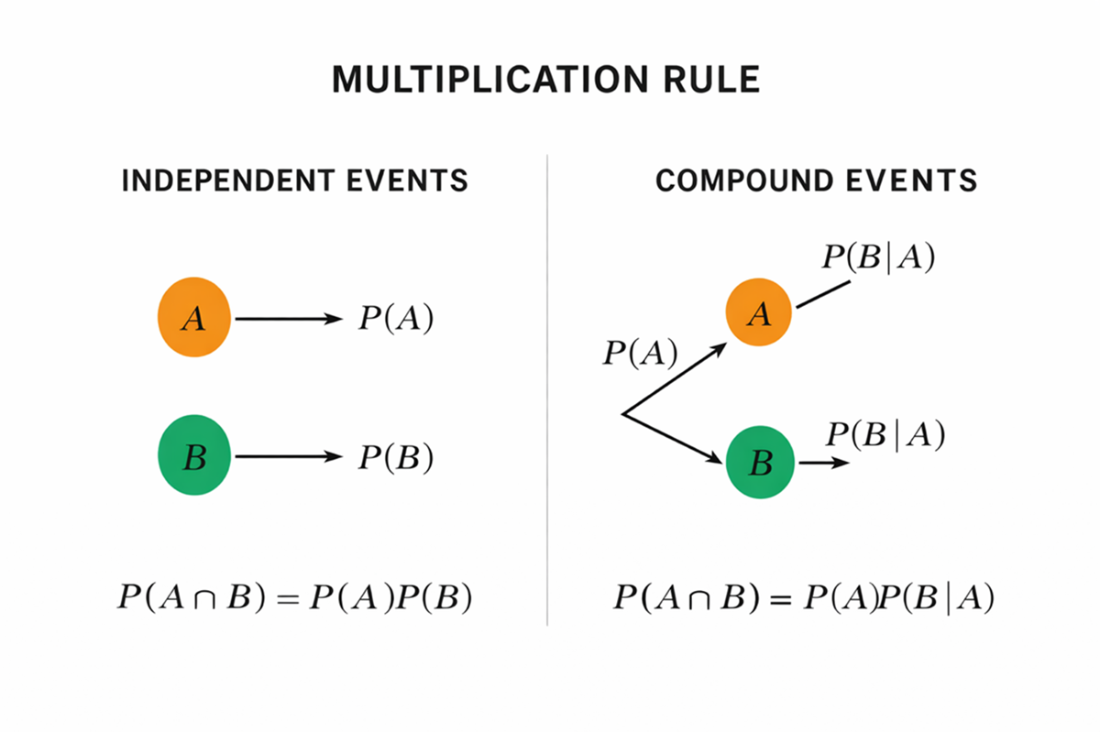
Both forms multiply probabilities along a path; the distinction is whether the later probability is conditional on the earlier event. section 2.3.4
The same logic extends to longer sequences: the joint probability is the probability of the first event multiplied by each later event's probability conditional on the events before it. For a word sequence, this means combining the probability of each word given the preceding words. section 2.3.4
The rule is a foundation of Bayes' theorem and Bayesian inference, but it also supports probabilistic models that reason over related observations or time steps. It was established before Bayes, who combined probability rules into a framework for learning from evidence. section 2.2.3 section 2.3 section 2.3.4



