Binomial distribution
A binomial distribution is the probability distribution of the number of successes in a fixed number of independent trials, each with the same probability of success.

Statistics Every Programmer Needs
A binomial distribution gives the probabilities of the number of successes in a fixed number of independent binary trials with a common success probability.
- How it is used
- Models binary outcomes for probability analysis, risk assessment, forecasting, and decision-making across manufacturing, healthcare, and market research.
- How deep it goes
- Defines assumptions, parameters, the probability mass function, manual calculations, SciPy implementation, and plotted comparisons.
- Examples
- Uses coin flips, quality-control pass/fail inspections, medical test results, binary surveys, and twenty-trial probability calculations.
- What you can do after
- Apply it via NumPy and SciPy to calculate and visualize probabilities for specified numbers of successes.
Read how Statistics Every Programmer Needs explains binomial distribution →

Math and Architectures of Deep Learning
A discrete probability distribution giving the chance of exactly k successes in n independent trials with constant success probability π.
- How it is used
- Models success counts from repeated binary trials and supplies a probabilistic alternative to direct yes/no prediction.
- How deep it goes
- Derives the count probability from trial sequences, gives mean and variance, and verifies implementation numerically.
- Examples
- Uses celebrity-photo selection, an eight-row three-trial outcome table, PyTorch log probabilities, and sampled moments.
- What you can do after
- Apply it via PyTorch, calculate exact count probabilities, evaluate log probabilities, and compare sampled moments with theory.
Read how Math and Architectures of Deep Learning explains binomial distribution →
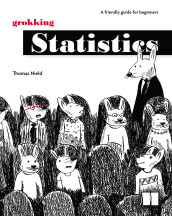
Grokking Statistics
A binomial distribution gives the probabilities of obtaining a specified number of successes in a fixed number of independent Bernoulli trials.
- How it is used
- Uses repeated-trial probabilities to judge whether an observed success count could reflect ordinary random variation.
- How deep it goes
- Defines n, p, and k, then calculates or simulates outcome probabilities without deriving the distribution mathematically.
- Examples
- Demonstrates waterproof MP3 players, coin tosses, Python simulations, probability tables, and distribution plots.
- What you can do after
- Apply it via SciPy to calculate exact-success probabilities and probabilities for ranges such as eight or fewer successes.
Read how Grokking Statistics explains binomial distribution →

Machine Learning System Design
A probability distribution for the number of successes in a fixed number of independent Bernoulli trials with a common success probability.
- How it is used
- Uses independent binomial sampling to make bootstrap-based validation faster and easier to parallelize.
- How deep it goes
- Explains the binomial-to-Poisson approximation and its computational rationale, but does not derive the distribution mathematically.
- Examples
- Demonstrates binomial(n,1/n) sampling for bootstrap datasets and evaluates resulting recall distributions.
- What you can do after
- Apply it to replace multinomial bootstrap sampling with independently parallelizable draws in large validation datasets.
Read how Machine Learning System Design explains binomial distribution →
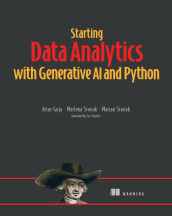
Starting Data Analytics with Generative AI and Python
A binomial distribution gives the probabilities of the number of successes in a fixed number of independent Bernoulli trials with a common success probability.
- How it is used
- Models counts of binary successes across repeated trials in conversion, quality-control, and advertising analyses.
- How deep it goes
- Defines the distribution and clarifies its n+1 aggregate outcomes through a ten-trial example.
- Examples
- Uses coin flipping, A/B-test conversions, quality-control pass rates, advertising clicks, and ten-trial success counts.
- What you can do after
- Evaluate/understand whether binary-trial data represent individual outcomes or counts of successes across multiple trials.
Read how Starting Data Analytics with Generative AI and Python explains binomial distribution →

Fabulous Adventures in Data Structures and Algorithms
A binomial distribution gives the probabilities of obtaining each possible number of successes in a fixed number of independent trials with the same success probability.
- How it is used
- Models observed success counts and supplies likelihoods for updating beliefs about an uncertain coin’s fairness.
- How deep it goes
- Defines the probability calculation and implements sampling, while using a linear algorithm appropriate for small trial counts.
- Examples
- Uses ten coin flips, nine observed heads, fairness priors, posterior histograms, and a C# distribution implementation.
- What you can do after
- Apply it via C# to weight success counts, sample binomial outcomes, and update fairness beliefs from observed evidence.
Read how Fabulous Adventures in Data Structures and Algorithms explains binomial distribution →
Related concepts
- probability distributionkind of · A probability distribution is a mathematical specification assigning probabilities to the possible values or outcomes of a random variable, with total probability one.
- Bernoulli distributionequivalent to · A Bernoulli distribution is a discrete probability distribution for one binary outcome, assigning probability p to one outcome and 1−p to the other.
- rotational gateuses · A rotational gate is a single-qubit quantum gate that rotates a qubit’s state by a specified angle about the Y axis of the Bloch sphere.
- Poisson distributionequivalent to · The Poisson distribution is a discrete probability distribution that models the count of events occurring independently at a constant average rate within a fixed interval or exposure.
- multiplication ruleuses · The multiplication rule determines a combined count or probability by multiplying the numbers of choices or the relevant probabilities at successive stages.
These guides are generated from the text of Manning books by Manning's knowledge graph and link to the sections they draw on. The full books are available on liveBook and at manning.com.