The multiplication rule finds the probability that two events occur together. For events E and F, P(E ∩ F) = P(E) · P(F|E). If they are independent, this becomes P(E ∩ F) = P(E) · P(F). section 8.2
Estimating emails with two words
If 20% of emails contain “lottery” and 10% contain “sale,” assuming the words are independent gives an estimate of 2% containing both: 0.20 · 0.10. section 8.2
Figure 8.11 Say 20% of the emails contain the word lottery, and 10% of the emails contain the word sale. We make the naive assumption that these two words are independent of each other. Under this assumption, the percentage of emails that contain both words can be estimated as 2%, namely, the product of 20% and 10%.
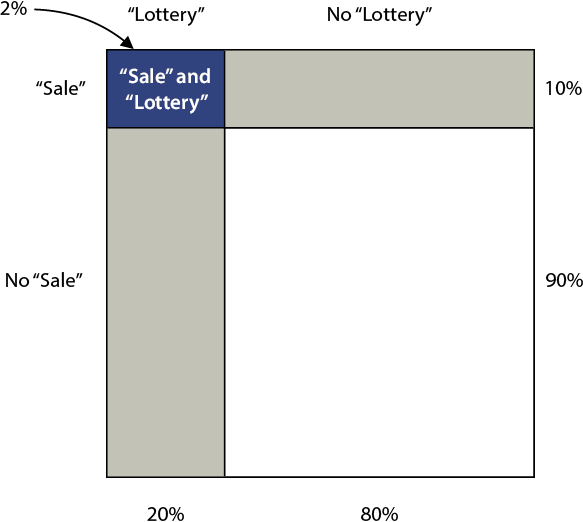
See how the independence assumption turns the two word probabilities into an estimate for their joint probability. section 8.2

