Pseudocode is a mix of English and programming written before executable code. It turns a problem into ordered steps, showing where to get input, display output, make decisions, and repeat actions. section 2.3
Use pseudocode as a bridge from understanding a problem to organizing code:
- Understand the task, including its inputs, outputs, and possible behaviors. section 12.1
- Sketch the process, create test cases, and turn the important steps into words. section 12.1
- Mark natural divisions such as initialization, algorithm steps, conditionals, loops, and cleanup. section 19.3
- Use the outline to decide whether the problem needs to be broken into smaller pieces before coding. section 19.3
A small algorithm outline
Get a radius from the user. Apply a formula. Show the result. Repeat steps 1–3 until the user says to stop. This outline describes the program’s structure without requiring valid programming syntax. section 2.3
Figure 2.3. This is the ideal way to approach solving a problem with programming. Understand the problem before you write any code. Then test the code that you write and debug it as necessary. This process repeats until your code passes all tests.
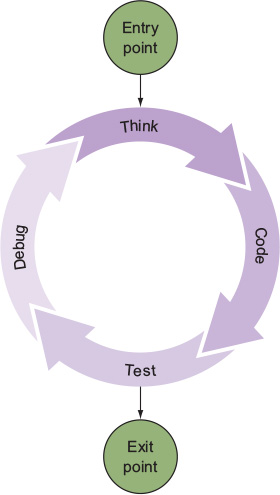
Follow the cycle from understanding the problem to writing code, testing it, debugging it, and repeating until the tests pass. section 2.3