liveBook · Manning

Public ip address

As explained in Fundamentals of Cybersecurity

A public IP address is a globally unique address routable on the public Internet.

A public IP address is a globally unique address that can be reached across the public Internet. With IPv4 addresses in limited supply, Network Address Translation (NAT) lets many devices share one public IP address. section 11.5.2

One address, many devices

Thousands of devices can share a single public IP address through NAT. Seeing one public address therefore does not necessarily mean only one device is using it. section 11.5.2

Figure 11.7 Illustration of Network Address Translation (NAT)
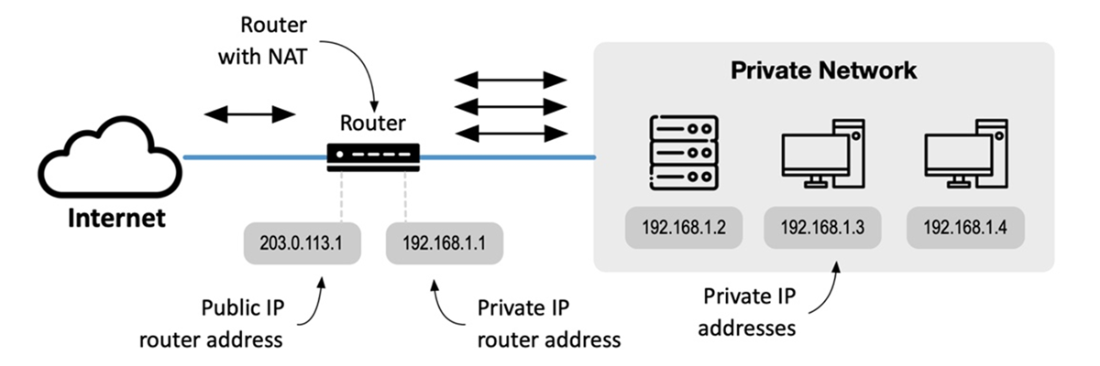
The diagram illustrates how NAT allows devices to share a public IP address. section 11.5.2


How Fundamentals of Cybersecurity covers it

How deep it goes
Defines the address and explains NAT sharing, but does not provide configuration steps.
Examples
Uses thousands of devices sharing one public address and a NAT diagram.
What you can do after
Evaluate/understand why one public IP address may be shared by many devices.
How it connects
Connects public IP addresses to IPv4 exhaustion, NAT, and IPv6.

Also explained in

Compare how 3 books explain public ip address →

Related concepts

This explainer was generated by Manning's knowledge graph from the text of Fundamentals of Cybersecurity. The section links point to the parts of the book it draws on.
