A pull request is a review boundary for proposed repository changes before integration. It gathers an isolated change set so engineers can assess correctness, architecture, library usage, and migration risk. section 2.11 section 2.3.2
The appealing shortcut is one large final PR after a long migration. That preserves a simple workflow but creates a costly review surface. Prefer a PR per migration step or layer when the codebase is large, while keeping each step clearly committed and isolated. section 2.11 section 2.3.2
Use a pull request as an operational control rather than a ceremonial handoff:
- Preserve the legacy state on the main branch and perform migration work on a dedicated branch. section 2.3.2
- Make every migration step a clearly defined commit, including smaller sub-tasks where useful. section 2.3.2
- Ask several engineers familiar with the legacy codebase to review the final or stepwise PRs. section 2.11
- Combine human review with AI-assisted review, checking for architectural missteps, deprecated libraries, misuse, duplication, and unsuitable patterns. section 2.11 section 2.3.2
Layered legacy migration
A JBoss-to-Spring migration can use a dedicated migration branch, with separate pull requests for the REST, data, service, and UI layers. A small application may use one final PR, but a larger application benefits from isolated reviews that reduce the final review burden. section 2.11 section 2.3.2
Figure 2.8 The final Pull Request contains all the stages.
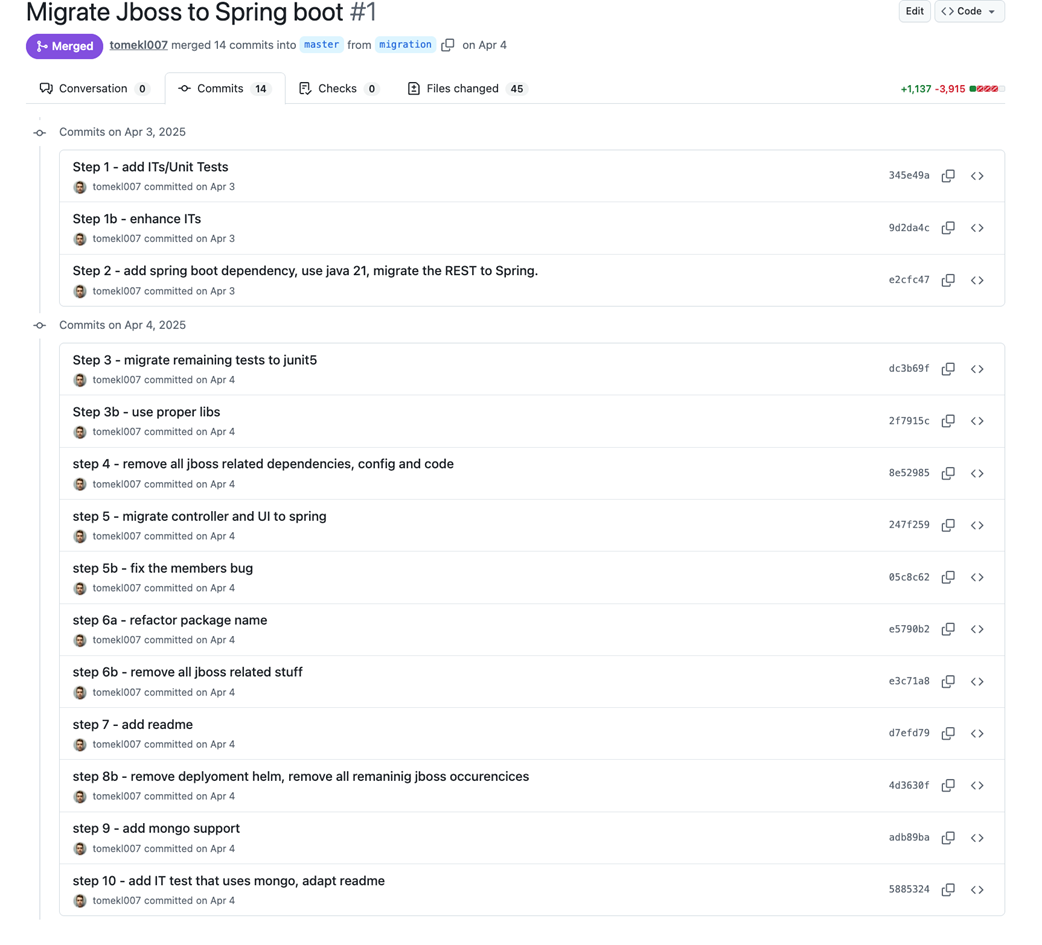
Use the figure to inspect how a final pull request can collect all migration stages, and why isolating those stages can improve review granularity. section 2.11






