A Clojure list is a concrete collection that is also a sequence. Use `list` to create a `clojure.lang.PersistentList` from zero or more arguments, including `nil`. With no arguments, it returns an empty list. Lists also have a language-level role: Clojure code is transformed into lists and symbols before compilation. section 9.4 section 9.4.1
Figure 9.6. A list formed from a chain of PersistentList objects. The EmptyList is a specialized version of PersistentList to handle the tail position.
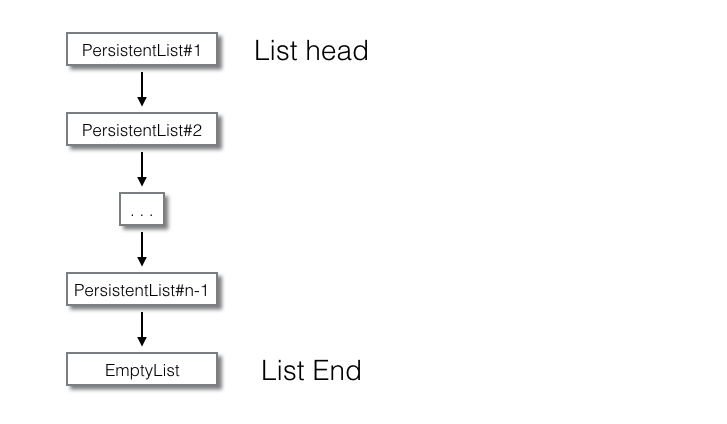
The diagram shows the linked chain behind a list, including the specialized empty-list tail. section 9.4.1
Create a list and push onto its head
`(list 1 2 3)` → `(1 2 3)`; `(list)` → `()`; `(conj (conj () 1) 2)` → `(2 1)`. Each `conj` adds its item at the head, so successive pushes appear in reverse order. section 9.4.1
That head-first behavior suggests a few practical choices:
- Use a list as a stack: `conj` pushes, while `peek` and `pop` inspect and remove the top. A nearest-smaller-value search uses this pattern to discard values that cannot be the next answer. section 9.4.1
- Use `(into () coll)` to reverse a collection by repeatedly pushing its elements onto an empty list. section 9.4.1
- Distinguish `list` from `cons` and `list*`: they produce compatible sequential results, but `cons` normally builds `clojure.lang.Cons` cells. A list supports constant-time `count` and optimized reduction; `cons` is used chiefly to build lazy sequences. section 9.4 section 9.4.2




















