A list is an ordered collection of values sharing one declared type. It can contain duplicates and is useful when a row needs a small, ordered group of items. section 4.5 section 4.5.1
ScyllaDB supports these list operations:
- Append or prepend lists with +; list + values appends, while values + list prepends. section 4.5.1
- Remove matching values with -, replace an indexed value, delete an indexed value, or replace the entire list. section 4.5.1
A list changing over time
Start with ['a', 'b', 'c']. Appending ['d', 'e'] produces ['a', 'b', 'c', 'd', 'e']; replacing index 0 with 'z' produces ['z', 'b', 'c', 'd', 'e']; deleting index 0 removes 'z'. Indexes outside the list produce an error. section 4.5.1
Use lists cautiously for repeated updates: appending is not idempotent, so repeating the same operation can create duplicate entries. Prefer a separate table when the collection is large or may grow without a known limit. section 4.5.1 section 4.5 section 4.7
Figure 4.3 Scylla supports storing multiple values in its collection data types: lists, sets, and maps.
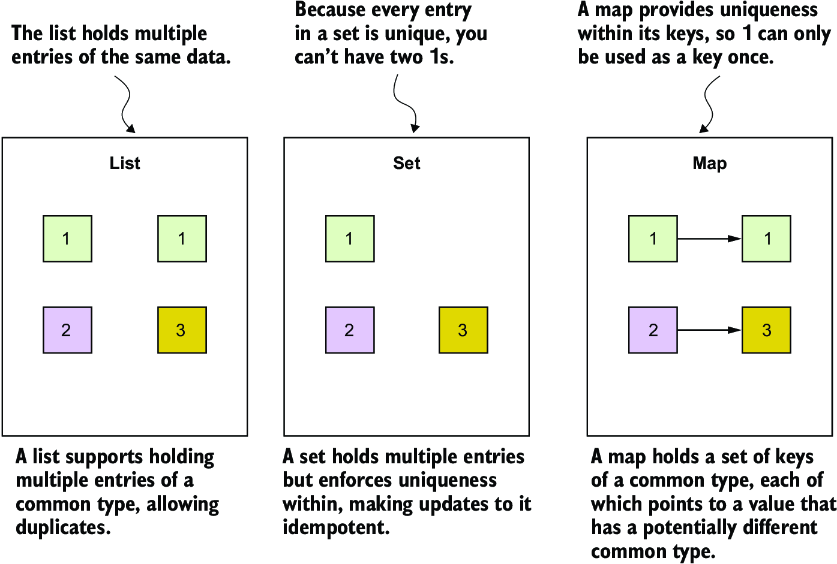
Compare lists with sets and maps to choose the collection type that matches ordering, uniqueness, and key-value requirements. section 4.5