A queue is a pile of jobs that a worker drains after the web response leaves. It turns background work into an asynchronous architectural edge: the user no longer waits, but failures can become invisible. section 9.1
Confirmation email
A web server can place a confirmation-email job on a queue and return success immediately; a worker processes the job later. If the worker fails, the user may never see the failure. Jobs can also back up or trigger a retry storm. section 9.1
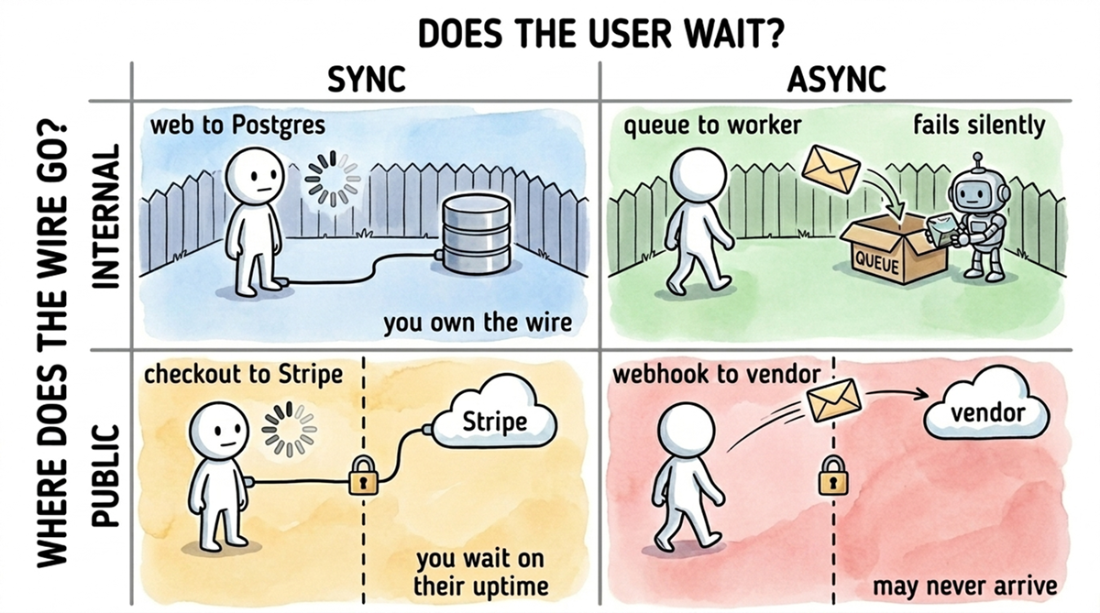
Figure 9.2 The four types of connections between programs, based on two questions: does the user wait (SYNC vs. ASYNC), and does the wire cross the internet (INTERNAL vs. PUBLIC)? Each quadrant has a distinct failure mode. INTERNAL+SYNC (web → Postgres): you control the wire. INTERNAL+ASYNC (queue → worker): fails silently to the user. PUBLIC+SYNC (checkout → Stripe): your uptime depends on a vendor's. PUBLIC+ASYNC (webhook → vendor): the message may never arrive.
Classify a queue-to-worker connection as internal and asynchronous, then use its distinct silent-failure mode when tracing architecture. section 9.1